

MINDFUL ROUTINES · AROMATHERAPY & HOME FRAGRANCE
Aromatherapy Oils for Candle Making: What to Know Before You Blend
A practical guide to choosing fragrance materials for candles—how essential oils differ from candle fragrance oils, why compatibility matters, how to think about fragrance load and scent performance, and what to test before making a finished candle.
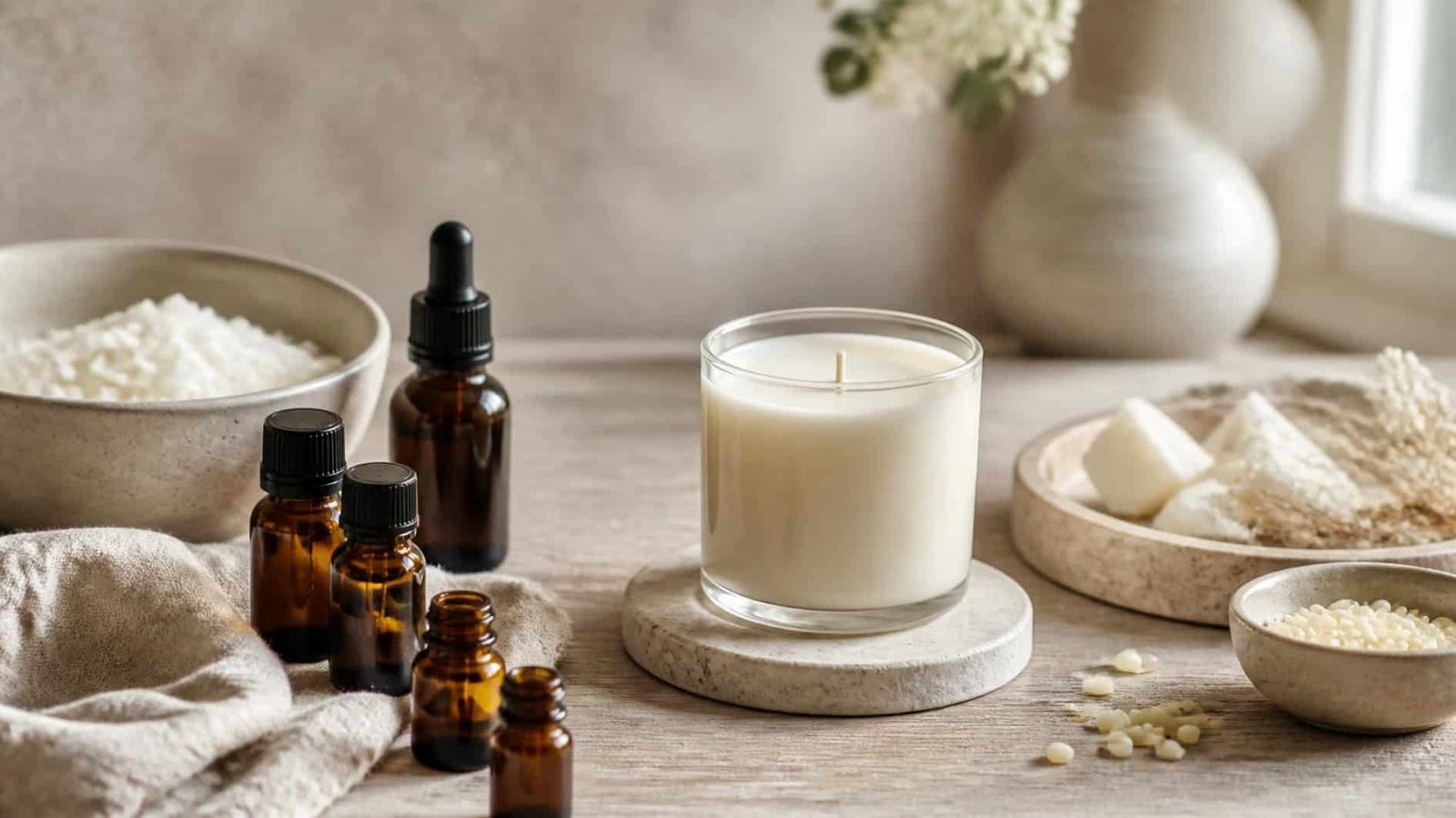
“Aromatherapy oil” is a broad retail description, not a guarantee that an oil is suitable for candle making. A bottle designed for a diffuser or oil burner may behave very differently in wax, and some products are not formulated for candles at all.
Before you blend anything into wax, identify exactly what the fragrance material is, confirm that the supplier supports candle use and read the technical information supplied with it. Candle fragrance is a formulation problem as well as a scent problem: the oil has to work with the wax, wick, vessel and intended fragrance level.
This guide focuses on home-fragrance design and practical testing. It does not treat essential oils as therapeutic ingredients or recommend adding fragrance to candles for health, sleep or wellbeing claims.
For a broader introduction to essential oils and fragrance oils, see our aromatherapy oils guide. If you are learning how to combine scent notes, our essential oil blends guide explains a simple lift, body and depth framework.
Not All Aromatherapy Oils Are Candle Oils
A product can smell suitable for a candle and still be the wrong material to put into wax. Diffuser oils, reed-diffuser refills, massage blends and other fragranced products may contain carriers or solvents intended for entirely different applications.
Use fragrance materials that the supplier explicitly identifies as suitable for candle making. If the intended use is unclear, treat that uncertainty as a reason not to add the product to wax.
This matters for performance as well as safety. An unsuitable oil may separate, affect the wax surface, change how the wick burns or produce an inconsistent scent result.
Essential Oils vs Candle Fragrance Oils
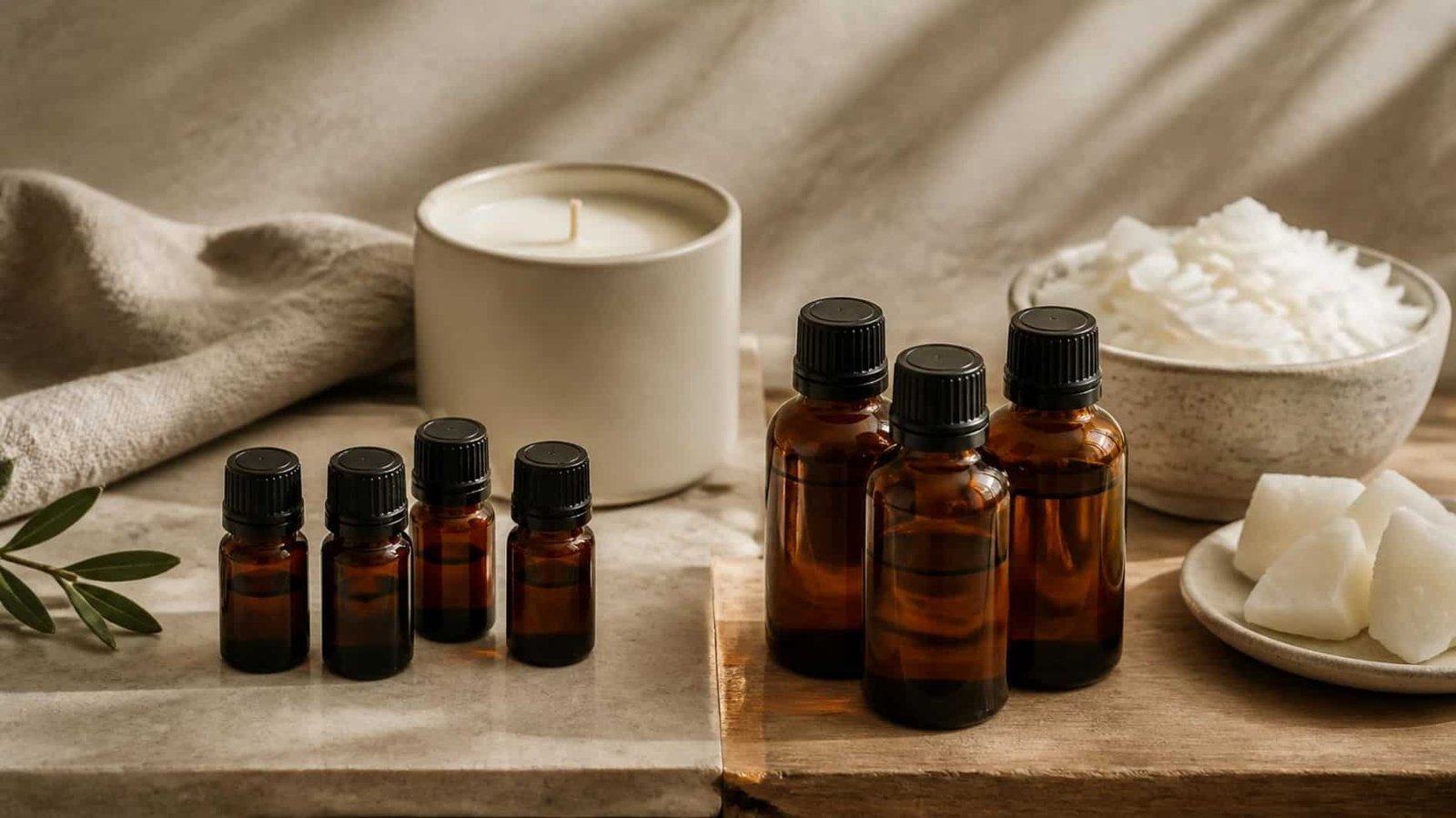
Essential oils are concentrated aromatic materials obtained from plant material. Their scent can change noticeably when heated, and some have relatively delicate or volatile profiles.
Candle fragrance oils are formulated fragrance compositions intended to perform in wax. Depending on the formula, they may contain natural materials, synthetic aroma materials or both.
Neither category is automatically superior. For candle making, suitability depends on the specific material, the wax system and the documentation supplied for that intended use.
| Question | Essential oil | Candle fragrance oil |
|---|---|---|
| Is it automatically candle-safe? | No | No—check the supplier’s intended use |
| Can the scent change in wax? | Yes | Yes |
| Should supplier limits be followed? | Yes | Yes |
| Does it still require burn testing? | Yes | Yes |
Start With Supplier Documentation
Good fragrance selection begins with technical information, not just the scent description.
- Intended application: confirm the oil is suitable for candles.
- Recommended usage: follow the supplier’s guidance for the relevant wax or product type.
- Safety Data Sheet: keep the current SDS where one is supplied or required.
- IFRA information: use the supplier’s current conformity information for the intended end-use category where applicable.
- Allergen and hazard information: particularly important if the finished candle will be sold.
Do not assume that because an oil is sold as “natural”, “pure” or “aromatherapy” it can be used at any concentration or in every wax system.
Match the Fragrance to the Wax
Soy, rapeseed, coconut, paraffin and blended waxes do not all accept or release fragrance in the same way. Even two waxes marketed under the same broad material name can have different manufacturer recommendations.
Use the wax supplier’s technical guidance as the starting point for fragrance compatibility, recommended fragrance range and processing method. If you change wax, treat it as a new formula that needs testing rather than assuming the old fragrance setup will transfer unchanged.
Fragrance Load Is Not a Universal Number
“Fragrance load” describes the amount of fragrance incorporated into the wax system, but there is no single percentage that is right for every candle.
The usable amount is constrained by the wax manufacturer’s specification, the fragrance supplier’s limits, the finished candle’s safety classification and how the formula actually performs in testing.
More fragrance can create problems rather than more scent. Excess oil may affect surface appearance, adhesion, burning behaviour or wick performance. Start inside the documented range and optimise through testing rather than chasing the highest possible load.
Do Not Use Flash Point as a Pouring Formula
The flash point listed for a fragrance is a safety property of that material under defined test conditions. It is not, by itself, an instruction telling you the exact temperature at which fragrance must be added to wax.
Use the processing temperatures recommended by the wax and fragrance suppliers. Candle performance depends on the whole system, so a single number taken from the fragrance documentation should not replace the manufacturer’s method.
Build the Blend Around Scent Structure
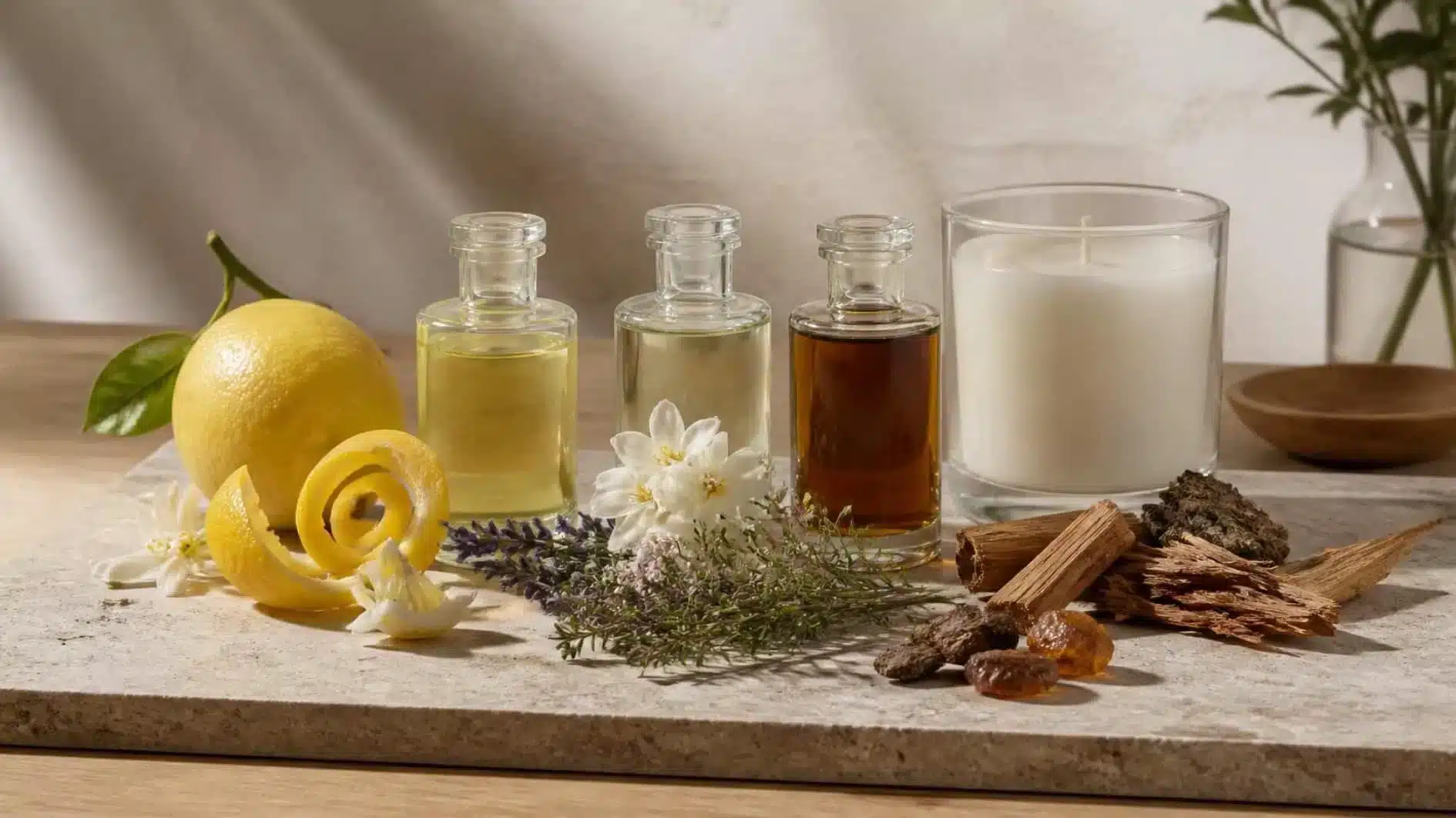
Once the materials are confirmed as suitable for candles, you can think about composition. A simple structure is often more useful than a long ingredient list.
- Lift: brighter citrus, fresh or lighter aromatic notes.
- Body: green, herbal, floral or rounded aromatic notes that carry the main character.
- Depth: woody, resinous or warmer notes that add weight and persistence.
Begin with two or three compatible fragrance materials and make the hierarchy clear. If every note competes equally, the finished candle can smell muddled even when the individual oils are attractive on their own.
For a more detailed blending method, see our essential oil blends guide.
Cold Throw and Hot Throw Are Different Tests

Cold throw is the fragrance you notice from an unlit candle. Hot throw is the fragrance released while the candle is burning.
A blend can smell strong in the jar and still perform quietly when lit, or it can seem modest cold and become much more noticeable during a burn. Judge both separately.
Do not evaluate hot throw by leaning directly over the flame or vessel. Assess the candle from a normal position in the room and follow safe burn-test practice.
Fragrance Can Change Wick Performance
The wick does not operate independently from the fragrance. Changing the oil, the concentration or even the blend proportions can alter how the candle burns.
That is why a wick that worked for an unscented candle or another fragrance is only a starting point. The finished combination of wax, fragrance, wick, dye if used, and vessel needs to be tested together.
Make Small, Controlled Test Batches

Changing several variables at once makes it difficult to understand why a candle improved or failed. Keep early test batches deliberately simple.
- keep the same wax and vessel while comparing fragrance versions
- change one blend proportion at a time
- record the fragrance amount precisely
- use the same preparation method for comparable tests
- burn-test the complete candle rather than judging scent alone
If a fragrance change also requires a wick change, record both versions separately so you can trace what produced the final result.
Allow the Candle to Set and Cure
Fragrance performance can change after the candle has fully set. Some wax systems also benefit from a defined cure period before evaluation.
Follow the wax supplier’s guidance rather than assuming every candle needs the same number of days. Compare like with like: if one test candle is evaluated immediately and another after a longer cure, the results are not directly comparable.
Keep a Formula and Test Record
A repeatable candle is a documented candle. Give each test version a simple code and record the variables that matter.
| Record | What to note |
|---|---|
| Wax | Exact product and batch where relevant |
| Fragrance | Supplier, product and blend proportions |
| Fragrance amount | Measured amount used in the finished formula |
| Wick | Series and size |
| Vessel | Internal dimensions and material |
| Process | Supplier-directed temperatures and method used |
| Evaluation | Cold throw, hot throw, flame behaviour, melt pool and visible issues |
Good records prevent you from accidentally recreating failed tests and make successful formulas easier to reproduce.
If You Plan to Sell Candles in the UK
A candle made for sale is not just a craft project; it is a consumer product. In Great Britain, scented candles may require classification and labelling under GB CLP depending on the hazards and concentrations in the finished mixture. Candle fire-safety, sooting and product-safety labelling standards are also relevant.
Keep supplier documentation for fragrance and other additives, assess the finished formulation and carry out appropriate candle safety testing. The Health and Safety Executive publishes current GB chemical-classification guidance, while the British Candlemakers Federation provides industry guidance on candle safety and applicable standards.
If you sell into Northern Ireland, the EU or other markets, do not assume the same regulatory route applies. Check the requirements for the market where the candle is placed on sale.
Common Candle-Fragrance Mistakes
- Using diffuser oil because it smells right. Intended application still matters.
- Assuming essential oil means candle-safe. It does not.
- Maximising fragrance load before testing a lower level.
- Using flash point as the sole guide for processing temperature.
- Changing wax, fragrance and wick at the same time.
- Judging the blend only from the bottle or cold candle.
- Skipping burn testing after a fragrance change.
- Selling a scented candle without checking the finished product’s safety and labelling requirements.
A Simple Candle-Fragrance Workflow
- Confirm intended use. Only shortlist fragrance materials supported for candle making.
- Read the documents. Check supplier usage guidance, SDS and relevant conformity information.
- Choose the wax first. Work inside the wax manufacturer’s fragrance and processing guidance.
- Build a simple scent structure. Start with two or three compatible fragrance materials.
- Make a small controlled test. Measure accurately and change one variable at a time.
- Allow the test to set appropriately. Follow the wax supplier’s evaluation guidance.
- Evaluate cold and hot throw separately.
- Burn-test the whole system. Wax, wick, fragrance and vessel must work together.
- Document the final formula. If selling, complete the relevant safety and labelling work for the finished candle.
Frequently Asked Questions About Aromatherapy Oils for Candle Making
Can I use aromatherapy oils in candles?
Only when the specific oil is supported for candle use by its supplier and is compatible with the wax system. “Aromatherapy oil” alone does not tell you whether the product belongs in a candle.
Can I use essential oils instead of candle fragrance oil?
Some essential oils can be used in candle formulations, but they still require supplier guidance and testing. Their performance in wax can differ substantially from their scent in the bottle or a diffuser.
How much fragrance oil should I put in candle wax?
Use the range specified for the exact wax and fragrance materials rather than relying on a universal percentage. The finished formulation also needs to perform safely in burn testing.
Does a lower flash point mean I should add the oil at a lower temperature?
Not as a general rule. Flash point is a safety property, not a complete candle-making temperature instruction. Follow the wax and fragrance suppliers’ processing guidance.
Why does my candle smell strong cold but weak when burning?
Cold throw and hot throw are different performance tests. Wax choice, fragrance composition, wick, fragrance amount, vessel and cure conditions can all affect the result. Change one variable at a time so you can identify the cause.
Do I need to test a candle again if I only change the fragrance?
Yes. Fragrance can alter burning behaviour and wick performance, so a new fragrance or blend should be treated as a formula change and tested as part of the complete candle system.
Blend for the Finished Candle
The best-smelling oil in the bottle is not automatically the best candle fragrance. Candle making asks more of the material: it has to be appropriate for wax, work at a suitable concentration, perform with the wick and vessel, and still smell coherent when the candle is both cold and burning.
Start with documented candle-compatible materials, keep the scent structure simple, work inside supplier limits and test the complete formula methodically. That produces a candle blend you can understand, refine and reproduce rather than one that depends on guesswork.

Leave a Reply