

MINDFUL ROUTINES · AROMATHERAPY & HOME FRAGRANCE
Natural Candles Guide: Beeswax, Soy and Rapeseed Wax Explained
How to choose natural candles—comparing beeswax, soy, rapeseed and coconut wax, reading labels, choosing shapes and burning candles safely so they last.

Candles are one of the simplest ways to change how a room feels in the evening. A single flame on a table, a row of tapers along a mantelpiece or a soy candle by the bath brings warmth, movement and a softer kind of light that lamps cannot quite reproduce.
Choosing between them has become more confusing, though. Labels promise natural, clean, eco or non-toxic, and wax types multiply: soy, rapeseed, coconut, beeswax, paraffin and blends of several. Many of those words have no fixed meaning, and a candle that suits one room or routine may be wrong for another.
This guide explains the main natural candle waxes, how to read candle labels, which shapes suit which settings and how to burn and look after candles so they last. It focuses on practical choices and safe use rather than health or environmental promises.
What Does “Natural Candle” Mean?
There is no single agreed definition of a natural candle. The phrase is usually used for candles made mainly from plant or animal waxes, such as soy, rapeseed, coconut or beeswax, rather than paraffin, which is refined from petroleum.
Because the term is not tightly defined, it helps to look past it. A candle described as natural may be a blend that includes paraffin, may use synthetic fragrance, or may have a wick or dye that the label does not mention. None of that is necessarily wrong, but it is worth knowing what you are buying.
The most useful questions are simple: what is the wax, or what is the blend; is the candle scented, and with what; and what kind of wick does it use? A reputable maker will usually tell you.
The Main Candle Waxes Compared
Each wax burns, looks and feels slightly differently. None is perfect, and the right choice depends on the shape of the candle, whether it is scented and how you plan to use it.
AT A GLANCE
Candle waxes compared
Beeswax
Soy
Rapeseed
Coconut blends
Paraffin
Beeswax
Beeswax is produced by honeybees and has a naturally warm golden colour and a faint honeyed scent of its own. It is firm and dense, which makes it well suited to pillars, tapers and moulded shapes that stand without a container. Beeswax candles tend to be more expensive than plant-wax candles, and natural colour varies from batch to batch.
Because beeswax already has its own gentle scent, it is usually sold unscented. Our guide to beeswax candles covers choosing, first burns and care in more detail, and you can browse our beeswax candles.
Soy wax
Soy wax is made from soybean oil. It is softer than beeswax, so it is mostly used in containers such as jars and tins, where it melts into a wide, even pool. It carries fragrance well, which is why many scented candles use it, either on its own or in a blend.
Rapeseed wax
Rapeseed wax is made from rapeseed oil, a crop widely grown in the UK and Europe. Like soy, it is soft and creamy and is generally used in container candles, often blended with other plant waxes.
Coconut wax and blends
Coconut wax is usually blended with other waxes, such as soy or rapeseed, to create a smooth, creamy finish in container candles. When a label says “coconut wax”, it often means a blend rather than pure coconut, so check the description if that matters to you.
Paraffin and mixed blends
Paraffin wax is refined from petroleum and remains the most common wax in mass-market candles. It is inexpensive and carries strong fragrance. Some candles blend paraffin with plant wax. If you prefer plant or beeswax candles, look for a clear description of the wax rather than relying on words such as natural on the front of the label.
A quick comparison
| Wax | Texture | Usually used for | Scent | Notes |
|---|---|---|---|---|
| Beeswax | Firm and dense | Pillars, tapers, moulded shapes | Faint natural honey; usually unscented | Golden colour; higher price |
| Soy | Soft | Jars and tins | Carries fragrance well | Creamy finish; widely used in scented candles |
| Rapeseed | Soft | Jars and tins, often blended | Carries fragrance well | Grown widely in the UK and Europe |
| Coconut blends | Very soft and smooth | Container candles | Carries fragrance well | Usually blended; check the description |
| Paraffin | Varies | All types | Carries strong fragrance | Petroleum-derived; common and inexpensive |
How to Read Candle Labels and Claims
Words such as natural, clean, eco and non-toxic appear on many candles, but they are marketing descriptions rather than standards. Treat them as a prompt to look for details, not as an answer.
- Look for the wax or blend named in the description, such as “soy and rapeseed wax blend”.
- Check whether the candle is scented and whether the fragrance is described as essential oil or fragrance oil.
- Look for the safety information: UK candles commonly carry warning labels about burning in sight and away from things that can catch fire.
- Check burn guidance, such as recommended burn time per session and how to trim the wick.
- Be cautious of health promises. A candle is a source of light and atmosphere; it is not a treatment, and any candle produces combustion by-products when it burns, which is one reason ventilation matters.
Scented or Unscented?
An unscented candle gives light and warmth without adding fragrance to the room. That makes it the easiest choice for dining tables, where scent can compete with food, and for homes where a diffuser or reed diffuser is already in use.
A scented candle is part of your home fragrance. It works best when its scent belongs to the same family as the other fragrances in the home, and when it is used in a room large enough not to feel overwhelmed. Our home fragrance guide explains how to choose scent families and layer them across rooms.
If you are unsure, a simple approach is to keep unscented beeswax or plain candles for tables and shared spaces, and choose one scented candle for the room where you relax in the evening.
Choosing a Candle Shape
The shape of a candle affects how long it burns, what it needs underneath it and where it looks most at home.
| Shape | What it is | Works well for | Needs |
|---|---|---|---|
| Pillar candle | Free-standing column, often wide | Mantelpieces, hearths, grouped displays | A heat-resistant plate or holder larger than its base |
| Taper candle | Tall, slim candle | Dining tables and formal settings | A holder with a snug socket |
| Container candle | Wax poured into a jar or tin | Side tables, bathrooms, scented candles | A heat-resistant surface underneath |
| Church or dinner candle | Classic slim pillar or long candle | Everyday table light | A stable candlestick or holder |
| Tealight | Small candle in a metal or clear cup | Lanterns, low accents | A holder; never directly on plastic surfaces |
| Moulded or sculptural | Decorative shapes, often beeswax | Shelves and occasional use | A plate or dish to catch wax |
Match the holder to the candle. Tapers need a socket that grips them upright; pillars need a base wider than the candle; container candles need a surface that can tolerate heat. Our natural candles collection includes holders and plates in iron, brass, glass and ceramic.
The First Burn and Tunnelling
With container and pillar candles, the first burn shapes every burn that follows. Wax has a kind of memory: if the first melt pool only reaches part of the way across, later burns tend to follow the same narrow path, a problem known as tunnelling.
To reduce the risk, follow the manufacturer’s guidance on first burn time and, where it suits the candle, let the melt pool reach close to the edge before extinguishing it. Wide candles generally need longer than slim ones. Avoid lighting a new candle if you only have a few minutes.
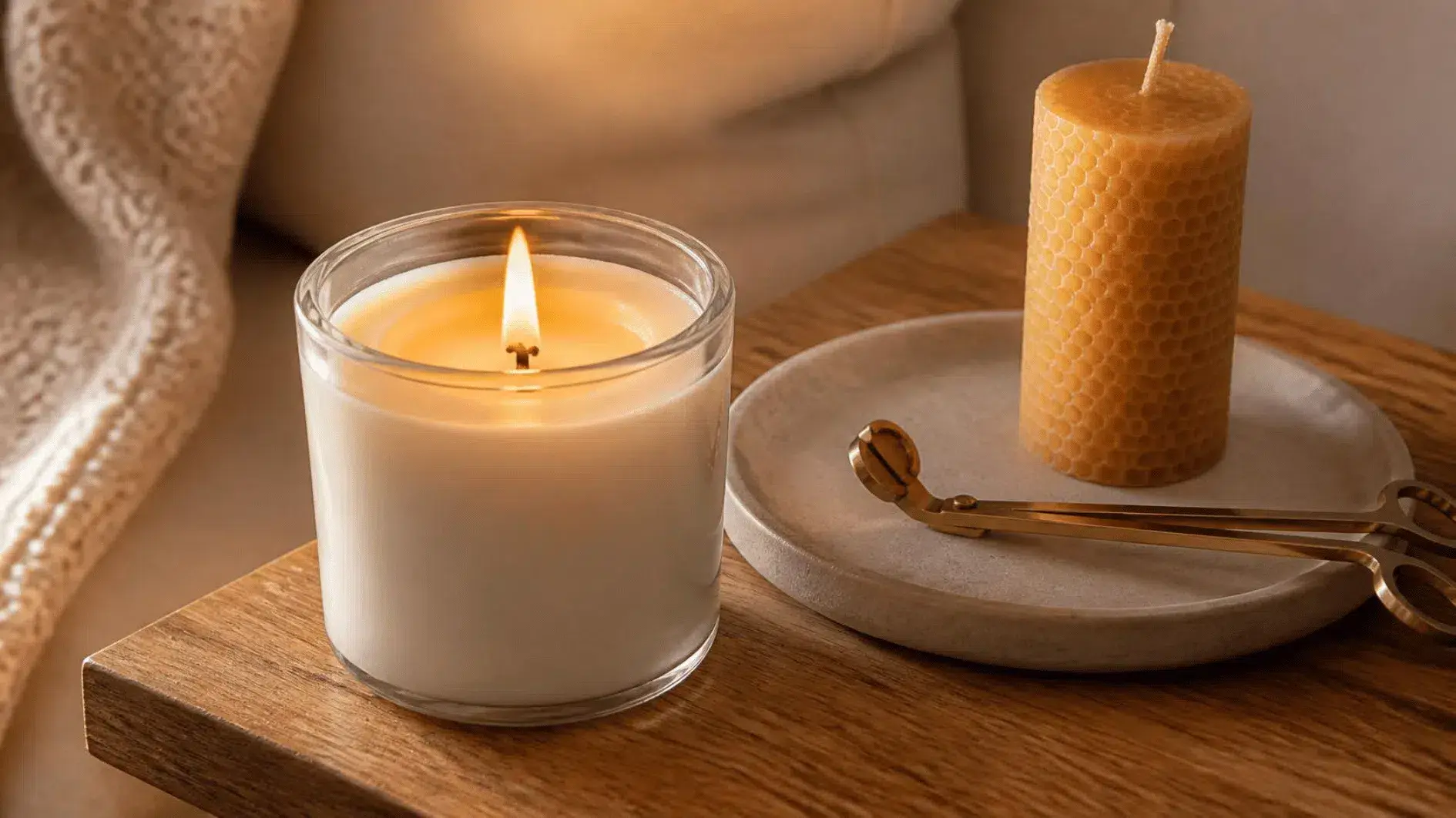
If a candle has already started to tunnel, burning it for a longer session can sometimes even out the surface. Do not try to fix tunnelling by digging into the wax or by placing anything around the candle that could trap heat.
Burning Candles Safely
Every candle, whatever its wax, is an open flame. Fire services repeat the same basic advice: never leave candles unattended, blow them out when you leave a room and before bed, use a heat-resistant holder on a stable surface, and keep candles away from curtains, paper, furniture and clothing (London Fire Brigade). Tealights get very hot and can melt through plastic, so always use a holder rather than placing them on a bath or television.
- Keep candles, matches and lighters out of reach of children and pets.
- Leave space between candles so that they do not heat one another.
- Avoid draughts, which make flames flicker, smoke and burn unevenly.
- Do not move a candle while it is lit or while the wax is liquid.
- Put candles out with a snuffer or by gently blowing, rather than with water.
If you want the look of candlelight where a flame is not suitable, such as a child’s room or near a window with curtains, fire services suggest flameless LED candles as a safer alternative (London Fire Brigade).
Wicks, Smoke and Soot
The wick controls how a candle burns. A wick that is too long tends to produce a tall, unsteady flame and more smoke, while a wick that is too short may drown in the wax.
- Trim the wick before relighting, following the length the manufacturer recommends.
- Remove debris, such as wick trimmings or match ends, from the wax pool.
- Keep candles out of draughts, which are a common cause of smoking and uneven burning.
- Stop and let it cool if a flame becomes very large, flickers constantly or smokes, then trim the wick and relight away from draughts.
How Long to Burn a Candle
Burn times vary with size, wax and wick, so the manufacturer’s guidance is the best starting point. As a general habit, avoid burning a candle for very long sessions, which can overheat the container or make the flame too large, and avoid very short sessions, which encourage tunnelling.
When only a little wax is left at the base of a container candle, stop using it, as the container can become very hot. With pillars and moulded candles, stop before the flame gets close to the holder or plate.
Candles and Indoor Air
Burning anything indoors adds to what is in the air, so it is sensible to keep rooms reasonably ventilated when candles are lit. The UK Health Security Agency notes that opening windows is the simplest way to improve ventilation at home, and that even brief or partial opening helps (UKHSA ventilation guidance). A well-trimmed wick and a draught-free position also help a candle burn more cleanly.
Where Candles Work Best at Home
- Dining table: unscented tapers or low pillars below eye level, so guests can see one another.
- Living room: a group of pillars on a hearth or tray, or a single scented candle in the evening.
- Bathroom: a container candle on a stable surface away from towels, used only while you are in the room.
- Hallway and shelves: better suited to flameless candles or reed diffusers, as these are places you pass through rather than stay.
- Bedroom: enjoy candlelight while reading, but always blow it out before sleep.
Candles look best alongside soft, low lighting. Our guide to layering light in a sitting room and our evening routine ideas show how candlelight fits into a calmer evening.
Storing Candles Between Uses
Store candles flat or upright in a cool, dark place, away from direct sunlight and radiators, which can soften wax or fade colour. Cover container candles with their lids to keep dust out of the wax, and wrap tapers so they do not bend or scratch. Beeswax may develop a pale “bloom” on its surface over time; this is a natural characteristic and can usually be buffed away with a soft cloth.
Common Candle Mistakes
- Lighting a new candle for only a few minutes.
- Leaving long wicks untrimmed.
- Burning candles in draughts or near curtains.
- Using a holder that is too small or not heat-resistant.
- Placing tealights directly on plastic surfaces.
- Trusting front-of-label words instead of the wax description.
- Using several strongly scented candles in one room.
- Leaving candles lit in an empty room or overnight.
A Simple Natural Candle Checklist
- Check the wax or blend named in the description.
- Decide whether you need scent or simply light.
- Match the shape to the setting and the holder to the candle.
- Give the first burn enough time.
- Trim the wick before every relight.
- Keep candles away from draughts and anything that can burn.
- Never leave a flame unattended.
- Store candles cool, covered and out of direct sun.
Frequently Asked Questions About Natural Candles
What is the most natural candle wax?
Beeswax, soy, rapeseed and coconut are the waxes most often described as natural. Beeswax is produced by bees; soy, rapeseed and coconut are plant-based. Many candles use blends, so check the description for the exact wax.
Are soy candles better than paraffin candles?
They are different rather than simply better. Soy is plant-based and is usually used in containers; paraffin is petroleum-derived and very common. Whichever you choose, trimming the wick, avoiding draughts and ventilating the room make the biggest practical difference to how a candle burns.
Are natural candles non-toxic?
“Non-toxic” is not a defined standard for candles, and any burning candle produces combustion by-products. Choose a wax you are comfortable with, follow the burn instructions and keep the room ventilated.
Why is my candle tunnelling?
Tunnelling usually happens when the first burns are too short for the melt pool to spread across the surface. Follow the manufacturer’s first-burn guidance, and allow longer sessions for wider candles.
Should I trim a candle wick?
Yes. Trimming the wick before each relight, to the length the manufacturer recommends, helps the candle burn more steadily and with less smoke.
Are unscented candles worth buying?
Yes, especially for dining tables and homes that already use other fragrance. Unscented beeswax candles in particular give warm light without adding a competing scent.
Choose Candles for Light, Not Labels
The most rewarding candles are not always the ones with the longest list of claims. They are the ones whose wax suits their shape, whose scent suits the room, and which are burned with a little care: a proper first burn, a trimmed wick and a safe, draught-free place.
Start with one or two candles for the rooms you use most in the evening, and explore our natural candles and beeswax candles when you are ready.
AROMATHERAPY & HOME FRAGRANCE
Explore Candles and Fragrance
Home fragrance
Home Fragrance Guide: Diffusers, Candles and Mists by Room
Candle fragrance
Aromatherapy Oils for Candle Making: What to Know Before You Blend
Evening routines
Evening Routine Ideas: Creating a Calmer Wind-Down
Layered light
Lighting for a Sitting Room: How to Layer Light for a Warmer Space
Candle holders
Candle Holders: How to Choose, Style and Use Them Safely

Leave a Reply