

SUSTAINABLE HOME · LOW-WASTE LIVING
Eco Friendly Bathroom Cleaner: How to Choose One Without Greenwashing
A practical guide to choosing an eco friendly bathroom cleaner—how to compare limescale performance, surface compatibility, dosage, refill systems, packaging and environmental claims without relying on vague green marketing.

Bathroom cleaners have a difficult job. They need to deal with soap residue, body oils, water marks and limescale while remaining compatible with surfaces such as ceramic, glass, chrome, sealed grout and sometimes natural stone.
That makes “eco friendly bathroom cleaner” a more useful buying question than simply asking for the greenest-looking bottle. The product still has to work, and the environmental case should be supported by evidence rather than colour, botanical imagery or vague language.
For the broader framework behind environmental claims, concentrates, packaging and certifications, see our eco friendly cleaning products guide. For simpler household ingredients and their limits, see our natural cleaning products guide.
Start With the Bathroom Cleaning Job
A bathroom does not have one type of dirt. Different surfaces collect different residues, and those residues respond to different cleaning chemistry.
- Soap residue and body oils: usually need surfactant action.
- Limescale: generally needs an acidic descaling product that is compatible with the surface.
- Water marks: may need descaling plus good rinsing and drying.
- Mould or mildew: may require a product specifically designed for that purpose.
- General dust and light marks: often need less product than heavily soiled areas.
Buying one heavily specialised product for every surface can create unnecessary duplication. The better aim is to understand which jobs genuinely need a dedicated formula.
Limescale Changes What You Need

In hard-water areas, limescale can be the main reason an everyday bathroom cleaner feels ineffective. Mineral deposits are different from grease and soap residue, so a neutral multi-surface cleaner may not remove them well.
An acid-based bathroom or limescale cleaner can be useful on compatible surfaces, but stronger is not automatically better. Follow the stated contact time and dilution instructions, rinse where required and avoid surfaces that the manufacturer excludes.
Check Surface Compatibility First

Bathroom finishes vary widely. Ceramic tiles, glass screens, chrome fittings, acrylic baths, sealed grout and natural stone do not all tolerate the same chemistry.
- Natural stone: acid cleaners can damage materials such as marble and limestone.
- Metal finishes: check care guidance for plated or specialist finishes.
- Acrylic and coated surfaces: avoid abrasive methods unless the manufacturer permits them.
- Grout and sealants: repeated exposure to unsuitable products can shorten their useful life.
The most environmentally responsible cleaner is not one that damages a surface and creates an avoidable repair or replacement.
Ingredients Matter, but Context Matters More
Ingredient lists can help you understand the type of formulation, but environmental performance depends on more than whether individual ingredients sound familiar.
Surfactants, acids, chelating agents, solvents, preservatives and fragrance materials can all serve legitimate functions in a bathroom cleaner. What matters is the finished formulation, the amount used, its intended surface, and the evidence behind any environmental claims.
For detergents sold in Great Britain, the Health and Safety Executive provides guidance covering detergent requirements such as surfactant biodegradability and ingredient information. Hazardous products must also follow applicable classification and labelling rules.
Natural Bathroom Cleaners Have Limits
Vinegar can help with some limescale because it is acidic, but that same acidity can damage natural stone and some specialist finishes. Bicarbonate of soda can provide mild abrasion, but it can scratch delicate surfaces and will not replace a proper surfactant where greasy soil needs to be lifted.
Natural ingredients are useful tools, not universal substitutes. Choose them for specific tasks rather than because “natural” sounds safer or greener.
How to Spot Bathroom-Cleaner Greenwashing
Bathroom-cleaner packaging often uses cues such as leaves, muted colours and botanical imagery. None of those features proves lower environmental impact.
- Vague claims: “planet friendly”, “green” or “earth kind” without explanation.
- Undefined comparisons: “less plastic” without a baseline or percentage.
- Single-attribute marketing: recyclable packaging presented as though it proves the whole product is sustainable.
- Badge-style graphics: symbols that look independent but are simply brand artwork.
- Absolute claims: language that suggests a product has no environmental impact.
The UK Competition and Markets Authority’s Green Claims Code sets out principles for environmental claims, including that they should be truthful, clear and substantiated and should not hide important information.
Look for Specific Environmental Claims
Specific claims are easier to evaluate than broad claims. Useful examples include a stated percentage of recycled plastic, a defined refill reduction, a published concentration ratio or certification against an independent standard.
If the claim is comparative, look for the reference point. “Uses 60% less plastic than our previous 750 ml bottle” is much more informative than “reduced plastic”.
Concentrates and Refills

Concentrated bathroom cleaners and refill formats can reduce packaging and the amount of water transported, but only if the system is practical and the dose is clear.
- Check how much ready-to-use cleaner the refill makes.
- Use the stated dilution rather than guessing.
- Keep the reusable bottle for as long as it remains serviceable.
- Check whether the refill itself is recyclable through your local system.
- Compare packaging per use rather than judging the original pack alone.
Packaging: Compare the Whole System
A glass bottle is not automatically a lower-impact choice than plastic, and a plastic bottle is not automatically a poor choice. Weight, recycled content, refillability, transport, durability and recyclability all matter.
For a bathroom cleaner used frequently, a durable trigger bottle combined with compact refills may be more useful than replacing the full dispenser every time.
Fragrance and Sensitive Households
Fragrance does not determine cleaning performance. If you enjoy scented products, choose them on preference. If a household member is sensitive to fragrance, a fragrance-free option may be more practical.
Avoid assuming that essential-oil fragrance is automatically less irritating than other fragrance systems. The useful question is whether the product is suitable for the people using it and whether relevant ingredient and hazard information is available.
Mould and Mildew Need the Right Product
Persistent mould is not simply another limescale problem. Ventilation, moisture control, leaks and condensation may all contribute, and cleaning alone will not solve an underlying moisture issue.
Where a mould-removal product is needed, use one intended for the surface and follow the instructions carefully. Do not mix it with other cleaners.
Cleaning and Disinfecting Are Different
Routine bathroom cleaning removes soil, soap residue and mineral deposits. Disinfection is a separate process with defined performance and contact-time requirements.
You do not need a disinfectant for every routine wipe-down. Where disinfection is appropriate, use a product designed for that purpose and follow its instructions exactly.
Build a Simple Bathroom Routine
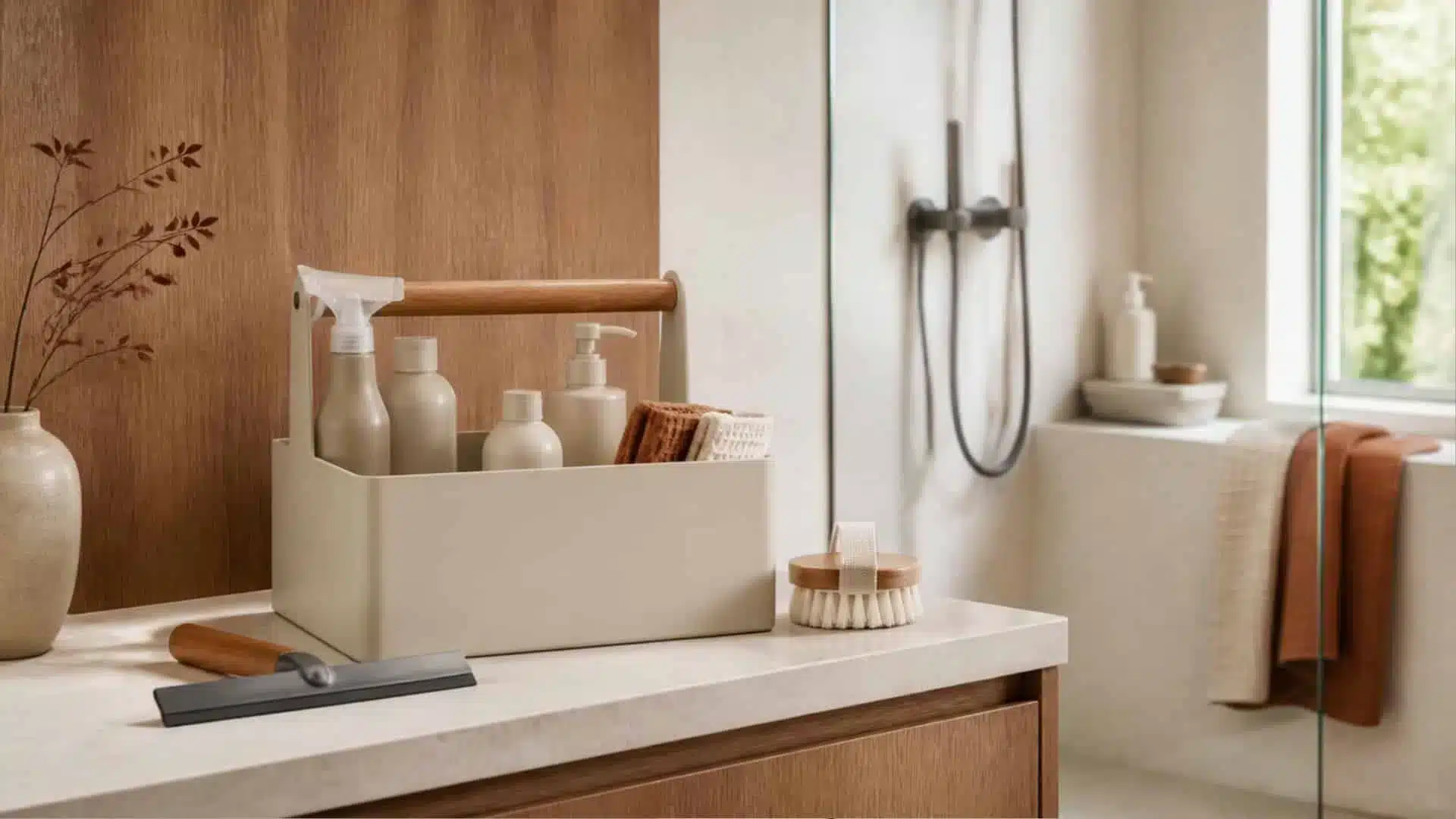
- Ventilate and dry surfaces. Reducing persistent moisture can prevent some cleaning problems from building up.
- Use one everyday cleaner for routine soil. Avoid unnecessary duplication.
- Keep a compatible limescale product where hard water makes it necessary.
- Use a targeted mould or disinfecting product only when the task calls for it.
- Use reusable cloths or tools appropriately and launder them between uses.
- Review packaging and refill options when you repurchase.
Compare Cost Per Use
A concentrate or refill may cost more at the till but less per cleaning task. Equally, a cheap ready-to-use spray can become expensive if it requires heavy application to work.
Compare the recommended dose, the number of refills or applications, whether the product replaces another cleaner and whether you are likely to use the system consistently.
Common Buying Mistakes
- Buying by packaging aesthetics instead of performance.
- Assuming one eco bathroom spray will remove grease, limescale, mould and disinfect equally well.
- Using acidic products on acid-sensitive stone.
- Choosing “natural” without checking the formulation or surface guidance.
- Buying a refill system that is difficult to keep using.
- Using more product than the stated dose.
- Mixing cleaners.
- Treating every routine clean as a disinfection task.
A Practical Buying Checklist
- Identify the main problem: routine soil, limescale, mould or hygiene.
- Check the surfaces: especially stone, acrylic and specialist finishes.
- Read the directions and dose.
- Look for specific environmental evidence.
- Compare concentrates and refills on a per-use basis.
- Assess packaging as a whole system.
- Check fragrance and ingredient information where relevant.
- Buy the smallest set of products that covers genuinely different tasks.
Frequently Asked Questions About Eco Friendly Bathroom Cleaner
What should I look for in an eco friendly bathroom cleaner?
Look for effective cleaning performance, clear surface guidance, sensible dosing, specific environmental claims, practical packaging and accessible ingredient and safety information.
Are eco bathroom cleaners good for limescale?
Some are, but not all. Limescale usually needs an acidic formulation, so check that the product is designed for mineral deposits and that it is compatible with the surface you are cleaning.
Can I use vinegar instead of bathroom cleaner?
Vinegar can help with some limescale, but it is not an all-purpose bathroom cleaner and can damage natural stone and some specialist finishes. It also does not replace a formulated disinfectant where disinfection is required.
Are refill bathroom cleaners always greener?
No. The refill should materially reduce packaging, work with a durable reusable bottle and be available consistently enough that you keep using the system.
How can I avoid greenwashing when buying bathroom cleaner?
Prefer specific, verifiable claims over vague terms such as “green” or “planet friendly”. Look for defined comparisons, recycled-content percentages, independent certifications and clear evidence behind environmental statements.
Choose Performance and Evidence Together
An eco friendly bathroom cleaner still needs to clean the bathroom well. Start with the job and the surface, then compare dosage, packaging, refill design and the evidence behind environmental claims.
The strongest choice is usually not the product with the most green language. It is the one that solves the cleaning problem with a sensible dose, clear instructions, appropriate surface compatibility and claims you can actually understand and verify.

Leave a Reply