

SUSTAINABLE HOME · LOW-WASTE LIVING
Eco Friendly Cleaning Products: What to Look For Before You Buy
A practical guide to comparing eco friendly cleaning products without relying on vague green language—covering ingredients, dosage, concentrates, refill systems, packaging, certifications and the evidence behind environmental claims.

Eco friendly cleaning products can be difficult to compare because environmental language is often much broader than the evidence behind it. A green bottle, a leaf icon or words such as “natural”, “eco” and “sustainable” may tell you very little about the product’s formulation, packaging, concentration, transport footprint or how much you need to use.
A better approach is to break the purchase into measurable questions. What does the product clean? How concentrated is it? How much do you use per task? What is the packaging made from? Is there a practical refill route? Are environmental claims specific enough to verify? And does the product give you clear safety and ingredient information?
That matters because a genuinely lower-waste cleaning routine is usually built from a small number of effective products used correctly—not a cupboard full of items that simply look greener.
What Does “Eco Friendly” Actually Mean?
“Eco friendly” is not a single technical specification. It can refer to different parts of a product’s life cycle: raw materials, manufacturing, concentration, packaging, transport, use or disposal. Two products can both make environmental claims while improving very different things.
For that reason, the strongest claims are specific. “Bottle made with 80% recycled plastic” gives you something concrete to assess. “Designed for cold-water cleaning” describes a use benefit that may reduce energy use in the right context. “Refill reduces packaging compared with buying another trigger bottle” can be meaningful if the comparison is clear.
Broad statements such as “good for the planet” or “green” deserve more scrutiny. The UK Competition and Markets Authority’s Green Claims Code guidance explains that environmental claims should be truthful, clear, substantiated and consider the product’s full life cycle where relevant.
Start With the Cleaning Job
Before comparing eco cleaning products, decide what you actually need to clean. Product duplication creates waste even when every bottle has strong environmental credentials.
- Everyday hard surfaces: often covered by one suitable multi-surface cleaner.
- Kitchen grease: may need stronger degreasing performance than a general dust-and-wipe product.
- Bathroom limescale: often needs an acid-based cleaner formulated for compatible surfaces. Our eco friendly bathroom cleaner guide explains how to compare limescale performance, surface compatibility, refills and environmental claims.
- Glass and mirrors: a low-residue formulation matters more than owning a heavily specialised system.
- Laundry and dishwashing: dosing, water hardness and machine efficiency become particularly important.
Our Household Cleaning Products guide turns this into a simple room-by-room routine and shows where one product can reasonably replace several overlapping bottles.
Read Ingredients and Safety Information
Ingredient transparency is useful, but ingredient names alone do not tell you whether one cleaner has a lower overall environmental impact than another. Concentration, biodegradability, hazard classification, dose and the way a product is used all matter.
For detergents sold in Great Britain, the regulatory framework includes requirements around surfactant biodegradability, ingredient information and labelling. The Health and Safety Executive’s detergents guidance explains the current GB requirements and the information manufacturers must make available.
Look for clear directions, hazard information where applicable, ingredient information and a manufacturer or supplier that makes technical details reasonably accessible. Avoid treating unfamiliar chemical names as automatically bad or familiar plant names as automatically benign.
Concentrates, Dosage and Product Efficiency
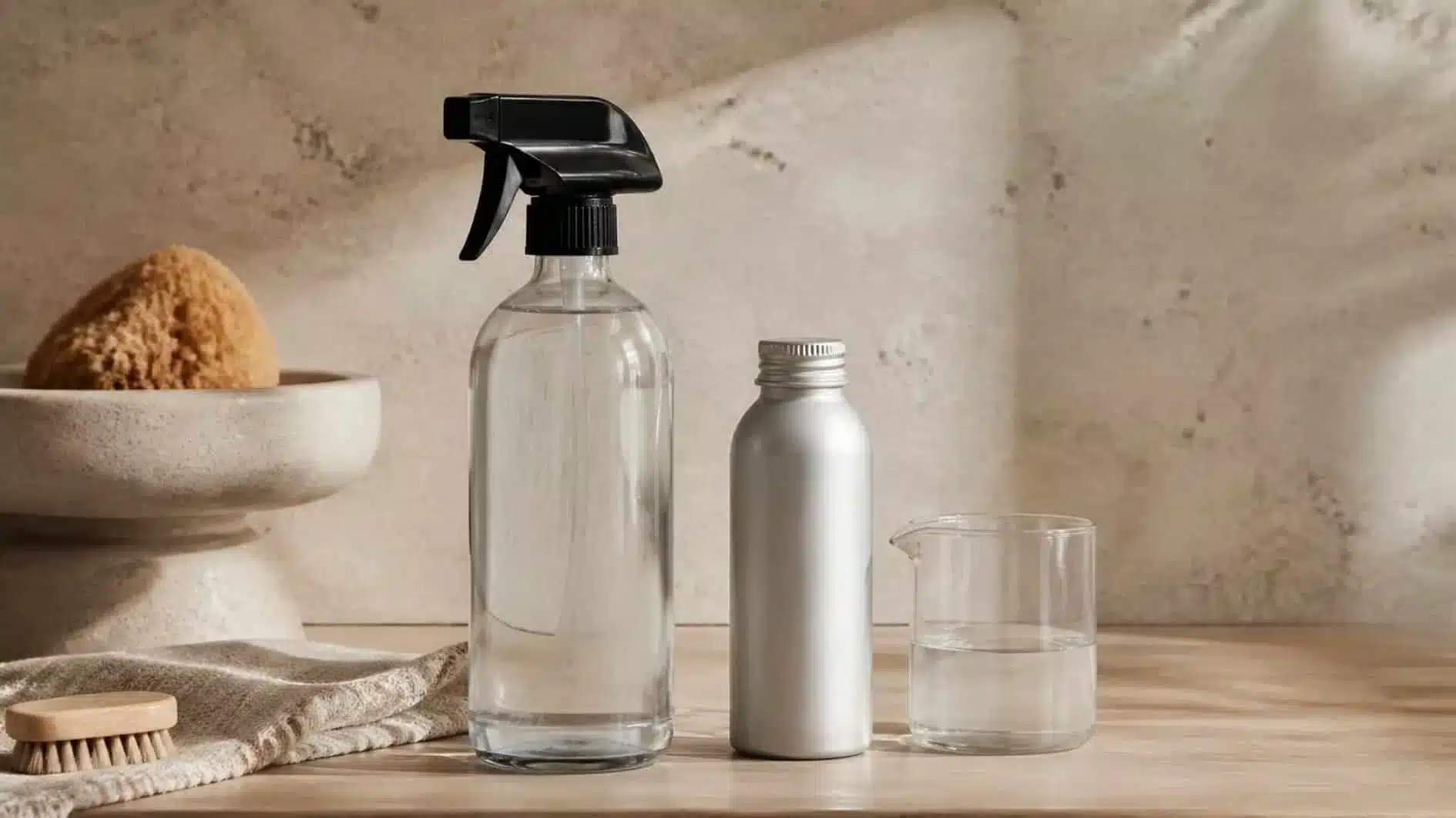
Concentrated cleaners can reduce the amount of packaging and water transported per cleaning task, but only when the product is dosed correctly and the format is practical enough to use consistently.
Check how many usable doses the pack provides rather than comparing bottle sizes. A 500 ml concentrate that makes ten refill bottles is a very different proposition from a 500 ml ready-to-use spray.
- Is the dilution ratio clearly stated?
- Does the pack include an accurate measuring method?
- Can the concentrate be used without encouraging accidental over-dosing?
- Does one concentrate replace several single-purpose products, or is it simply another bottle in the cupboard?
Using more product than necessary can erase some of the practical benefit of choosing a concentrated format.
Packaging: Look Beyond the Material

Plastic versus glass is not a complete environmental comparison. Packaging weight, recycled content, refillability, transport, breakage, local recycling infrastructure and how many uses the pack delivers all affect the picture.
For everyday cleaning, lightweight packaging with verified recycled content may sometimes be more practical than a heavier material that looks more premium. Equally, a durable trigger bottle used through many refill cycles may be preferable to repeatedly buying complete spray bottles.
Useful packaging questions include:
- How much packaging is there per use?
- Is recycled content stated as a percentage?
- Can the main bottle genuinely be reused many times?
- Is the refill pack itself recyclable where you live?
- Are pumps, sleeves and mixed materials easy to separate?
When Refill Systems Make Sense
A refill system is useful when it actually changes your purchasing pattern. The environmental benefit is harder to defend if the reusable bottle is replaced frequently, the refill travels in disproportionately heavy packaging or the system is so inconvenient that you abandon it after one or two uses.
Look for a refill that uses materially less packaging than the original container, keeps the dosing process simple and is available reliably enough that you will keep using it.
Certifications and Independent Standards
Independent environmental labels can be more useful than a brand’s own green symbols because they usually work against published criteria. They are not identical, and no certification replaces reading the product instructions, but they can provide a more structured basis for comparison.
For example, the EU Ecolabel cleaning criteria cover factors such as restrictions on hazardous substances, ingredient sourcing, packaging and use guidance across several detergent categories. Availability in the UK varies, so treat it as one recognised benchmark rather than the only acceptable mark.
When you see any environmental certification, check who operates it, whether the criteria are public, what part of the product it assesses and whether the licence or certification can be verified.
How to Spot Weak Green Claims
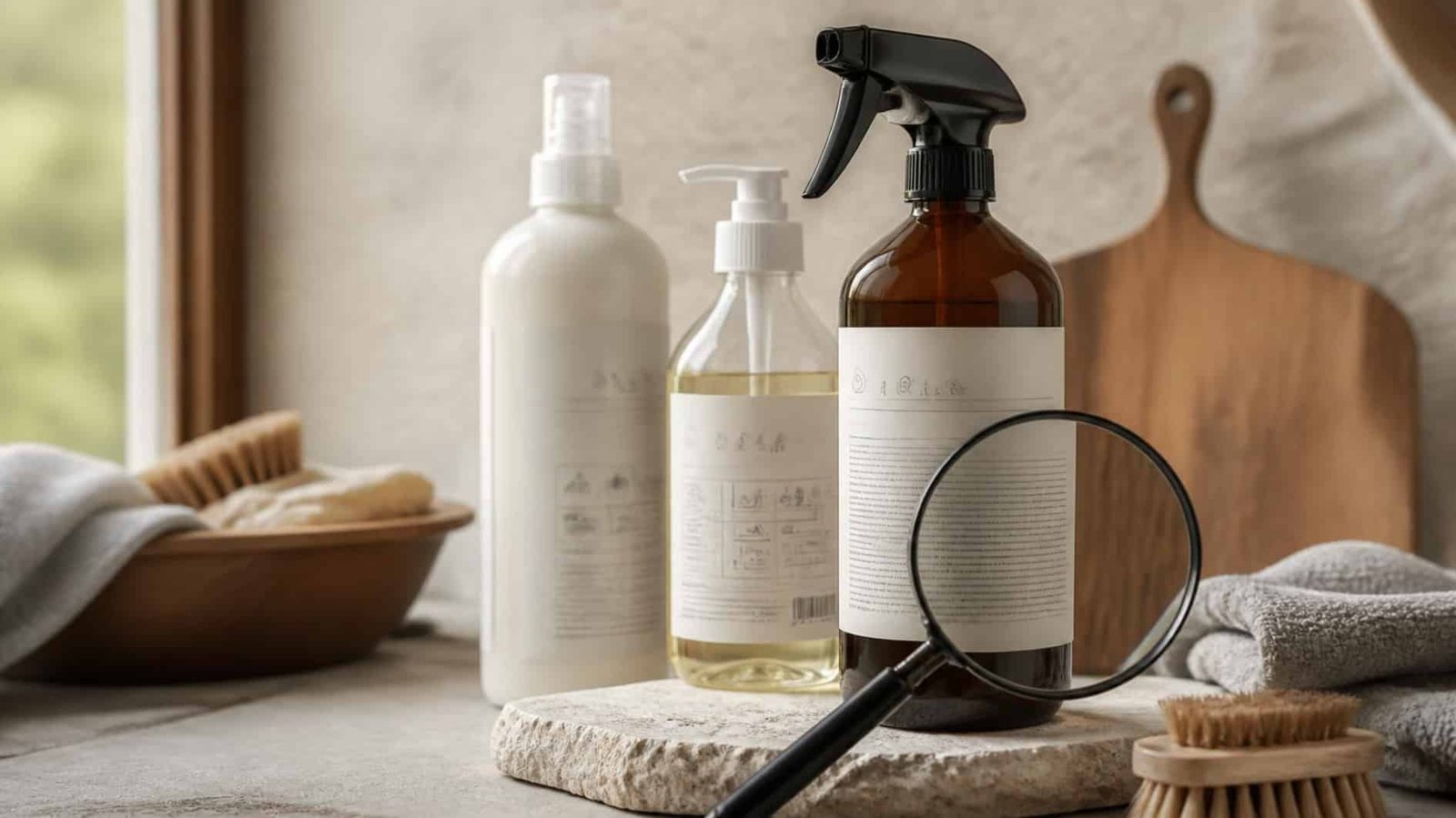
Greenwashing is not always an outright false statement. It can also appear as selective information that makes a product look environmentally preferable without giving enough context to judge the overall claim.
- Vague language: “planet safe”, “earth kind” or “eco conscious” with no measurable explanation.
- Undefined comparisons: “uses less plastic” without saying less than what or by how much.
- One highlighted feature: recyclable packaging presented as though it proves the entire product has a low environmental impact.
- Unverifiable symbols: badge-style graphics that resemble certifications but are simply brand artwork.
- Missing trade-offs: strong claims that ignore a material part of production, use or disposal.
The CMA updated its green-claims guidance collection in 2026 with additional supply-chain guidance, reinforcing that retailers, manufacturers and suppliers all have responsibilities around the environmental claims they communicate.
What “Sustainable Cleaning Products” Should Tell You
Searches for sustainable cleaning products often lead to the same products described as eco friendly cleaning products. For buyers, the useful distinction is not the wording but the evidence.
A credible sustainability story should identify the area being improved: lower packaging weight, verified recycled content, concentrated transport, certified ingredients, renewable-energy manufacturing, independently assessed formulation criteria, or another specific factor. It should also avoid implying that one improvement eliminates every other environmental impact.
That is why we treat sustainable cleaning products as part of this broader topic rather than as a separate product category. The shopping intent is essentially the same: compare environmental claims and choose a practical cleaner with evidence behind them.
Natural Does Not Mean Automatically Better
A natural origin does not guarantee a product is safer or lower impact. For what simple ingredients such as vinegar and bicarbonate of soda can and cannot do, read our natural cleaning products guide.
Fragrance, Allergens and Sensitive Households
Fragrance is a preference, not a measure of cleaning performance. Some households prefer fragrance-free products; others are comfortable with scented cleaners. The useful comparison is whether fragrance ingredients and relevant allergen information are disclosed in line with the applicable rules and whether the product is suitable for the people using it.
If someone in the household has asthma, allergies, skin sensitivity or another specific health concern, product-specific advice from an appropriate healthcare professional is more useful than relying on broad marketing labels such as “natural” or “gentle”.
Cleaning and Disinfecting Are Different Jobs
Most everyday surfaces need cleaning, not disinfecting. Our household cleaning products guide explains when a disinfectant is genuinely useful.
Build a Smaller Cleaning Routine
Fewer, better-chosen products are usually easier and cheaper to manage. Our minimal household cleaning kit sets out the core products most homes need.
Compare Cost Per Use, Not Bottle Price
A cheaper bottle is not necessarily cheaper to use. Concentrates, tablets, powders and refill systems can only be compared fairly when you look at the number of effective cleaning tasks they provide.
Use the recommended dose to estimate cost per application. Then consider whether the product replaces another cleaner, whether you are likely to over-dose it and whether the refill system requires additional hardware or subscriptions.
Value is strongest when the product is effective enough that you use the correct amount, finish the pack and repurchase deliberately rather than constantly trying alternatives.
Common Buying Mistakes
- Buying by colour palette. Neutral packaging and botanical graphics are design choices, not environmental evidence.
- Assuming “plant-based” explains the whole formulation.
- Choosing glass automatically. Heavier packaging is not always the lower-impact option.
- Ignoring dosage. A concentrated product used carelessly can create unnecessary waste.
- Buying a refill system without checking refill availability.
- Confusing cleaning with disinfecting.
- Using “natural” as a substitute for reading instructions and hazard information.
- Replacing products before they are finished. Using what you already own responsibly is often the most immediate low-waste step.
A Simple Buying Checklist
- Define the job. Decide exactly what the cleaner needs to do.
- Check whether you already own something suitable.
- Read the usage directions. Compare the recommended dose, not just pack size.
- Look for specific environmental claims. Prefer numbers, defined comparisons and verifiable standards.
- Assess the packaging system. Consider weight, recycled content, refillability and local recyclability together.
- Check ingredient and safety information.
- Look for independent certification where useful.
- Calculate approximate cost per use.
- Buy the smallest useful system. Avoid creating a new category of product unless it solves a real cleaning need.
Frequently Asked Questions About Eco Friendly Cleaning Products
What makes a cleaning product eco friendly?
There is no single feature that makes a cleaner environmentally preferable in every respect. Look for specific evidence around formulation, concentration, packaging, refill systems, sourcing, certifications and use rather than relying on the phrase “eco friendly” alone.
Are sustainable cleaning products the same as eco friendly cleaning products?
In everyday shopping language, the terms overlap heavily. What matters is the evidence behind the claim. A product described as sustainable should still explain which environmental impacts are being reduced and how that improvement is measured.
Are natural cleaning products better for the environment?
Not automatically. Ingredient origin is only one part of the product’s environmental profile. Dose, biodegradability, manufacturing, packaging, transport and actual cleaning performance also matter.
Are refill cleaning products always more sustainable?
No. A refill system is most convincing when it materially reduces packaging, the reusable container lasts, the refill remains available and the format does not encourage wasteful dosing or extra purchases.
Should I choose glass cleaning bottles instead of plastic?
Material alone is not enough to decide. Consider packaging weight, recycled content, transport, breakage, reusability and whether the pack can actually be recycled through your local system.
Do eco cleaning products still need hazard labels?
Yes, when the formulation meets the relevant hazard-classification criteria. Environmental marketing does not replace chemical-safety labelling requirements. The HSE explains that cleaning products classed as hazardous must be labelled and packaged under the applicable GB CLP rules.
Choose Evidence Over Aesthetics
The most useful eco friendly cleaning products are not necessarily the ones with the strongest green branding. They are products that do the required job effectively, use a sensible amount of material per clean, communicate their formulation and instructions clearly, and support environmental claims with specific evidence.
Start by reducing overlap in your cleaning cupboard. Then compare concentrates, refills, packaging, certifications and claims on a per-use basis. A smaller, well-understood routine is easier to maintain—and much easier to evaluate—than a collection of specialised products bought mainly because they look sustainable. Explore our everyday essentials for simple, refillable household pieces.
LOW-WASTE LIVING · ECO CLEANING
Explore Eco Cleaning

Leave a Reply