

SUSTAINABLE HOME · LOW-WASTE LIVING
Household Cleaning Products: What You Actually Need for a Simple Routine
A practical guide to building a smaller cleaning cupboard—what household cleaning products cover most everyday jobs, where specialist cleaners are justified, and how to avoid buying several products that do essentially the same thing.
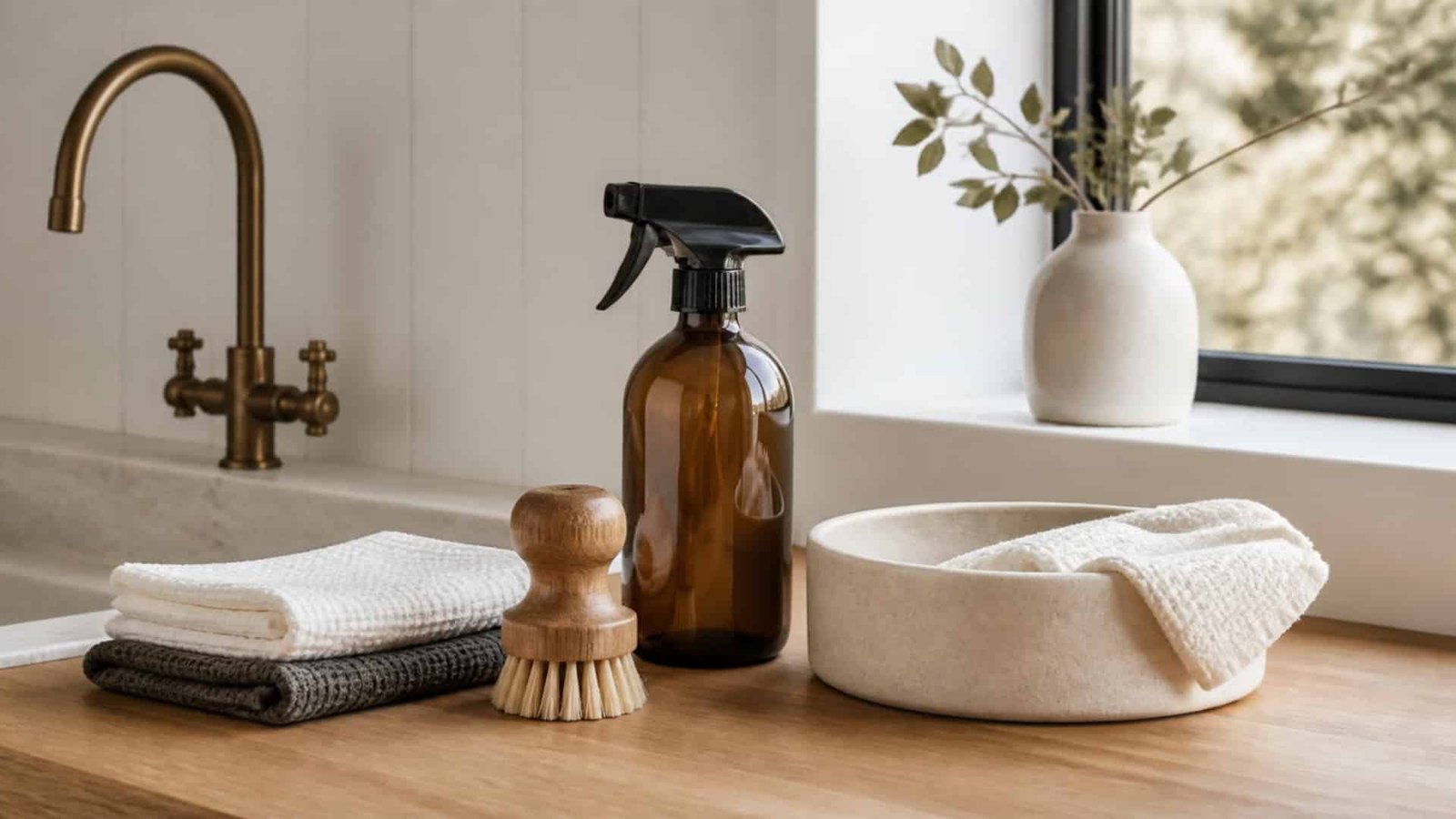
The cleaning aisle makes it easy to believe that every room, surface and type of dirt needs its own bottle. In practice, most homes can be maintained with a much smaller set of household cleaning products, provided each product has a clear job and is used on compatible surfaces.
A simple routine is not about using one product for absolutely everything. It is about separating genuinely different cleaning problems—everyday soil, grease, limescale, laundry, dishwashing and occasional specialist tasks—then avoiding unnecessary overlap inside each category.
For environmental claims, refill systems, packaging and certifications, start with our eco friendly cleaning products guide. If you prefer simpler ingredients where they make sense, see our natural cleaning products guide.
Why a Smaller Cleaning Cupboard Works
Most duplicated cleaning products differ more in positioning than in the job they perform. You may have a kitchen spray, an everyday surface spray and a “daily clean” spray that all cover similar sealed hard surfaces.
Reducing that overlap has practical advantages. You finish products before they expire or get forgotten, you learn which formulations work on which surfaces, and you make refill or concentrate systems easier to maintain because fewer product categories need replacing.
The aim is not minimalism for its own sake. A smaller cupboard works when each remaining product has a distinct purpose.
The Core Household Cleaning Products

A typical home can often be maintained with six or seven functional categories rather than a separate cleaner for every room.
| Product category | Main job | Essential for every home? |
|---|---|---|
| Everyday multi-surface cleaner | Routine soil on compatible hard surfaces | Usually |
| Degreaser | Heavy or cooked-on grease | Depends on cooking habits |
| Bathroom/limescale cleaner | Mineral deposits and bathroom soil | Useful in hard-water homes |
| Washing-up or dishwasher detergent | Dishes and food residues | Yes |
| Laundry detergent | Clothing and household textiles | Yes |
| Glass cleaner | Low-residue finish on glass and mirrors | Optional |
| Specialist cleaner | Stone, oven, mould, wood or another defined task | Only where needed |
1. A Good Everyday Multi-Surface Cleaner
This is the product that should earn the most space in the cupboard. A suitable multi-surface cleaner can cover routine wiping on many sealed worktops, cupboards, tables, tiles and other washable hard surfaces.
Check the manufacturer’s compatibility list rather than assuming “multi-surface” means every material. Natural stone, unsealed wood, specialist coatings and some electronics often need different care.
If the product is concentrated, measure it accurately. If it is ready to use, spray only enough to wet the area being cleaned rather than automatically coating the entire surface.
2. A Degreaser When You Actually Need One
For light kitchen soil, a good everyday detergent-based cleaner may already be enough. A dedicated degreaser becomes useful when you regularly deal with heavier cooking oils, extractor areas or residues that have built up over time.
Do not keep a strong degreaser simply because kitchens are expected to have one. If your everyday cleaner handles the job at its normal dose, the extra bottle may be unnecessary.
3. A Bathroom or Limescale Cleaner
Limescale is chemically different from grease and everyday surface soil. In hard-water areas, a bathroom cleaner with suitable descaling action can therefore justify its own place in a simple routine.
Surface compatibility is critical. Acidic limescale cleaners can damage natural stone and some specialist finishes. Our eco friendly bathroom cleaner guide explains how to compare limescale performance, refill systems, packaging and green claims without overlooking the surface itself.
4. Washing-Up or Dishwasher Detergent
Dishwashing is a specific cleaning system, so it deserves a product formulated for it. Hand washing-up liquid is designed to lift food oils and rinse from dishes. Dishwasher detergents are formulated for machine temperatures, water conditions and automated rinsing.
Use the product intended for the method you are using. Do not substitute hand washing-up liquid into a dishwasher.
5. Laundry Detergent
Laundry detergent has to work across water hardness, fabric types, soil levels and machine cycles. That makes it another product category worth keeping distinct rather than trying to replace it with a general-purpose household cleaner.
Dose according to the detergent instructions, load size and local water conditions. Over-dosing does not automatically improve cleaning and can leave residue or increase unnecessary product use.
6. Glass Cleaner: Optional for Many Homes
A dedicated glass cleaner is mainly about a low-residue finish. If your existing multi-surface product works well on mirrors or glass and is approved for those surfaces, you may not need a separate bottle.
If streaking remains a problem, technique can matter as much as the product: use a clean lint-free cloth, avoid over-applying cleaner and finish on a dry section of cloth.
7. Specialist Products Only for Specialist Jobs
Specialist cleaners are useful when a real compatibility or performance requirement exists. Examples can include oven cleaner, mould remover, natural-stone cleaner, wood-care products or manufacturer-specified appliance cleaners.
Before buying one, ask whether the job is recurring enough to justify a dedicated product. If it is only needed occasionally, buy the smallest sensible pack and store it safely.
Cleaning Tools Matter as Much as Products
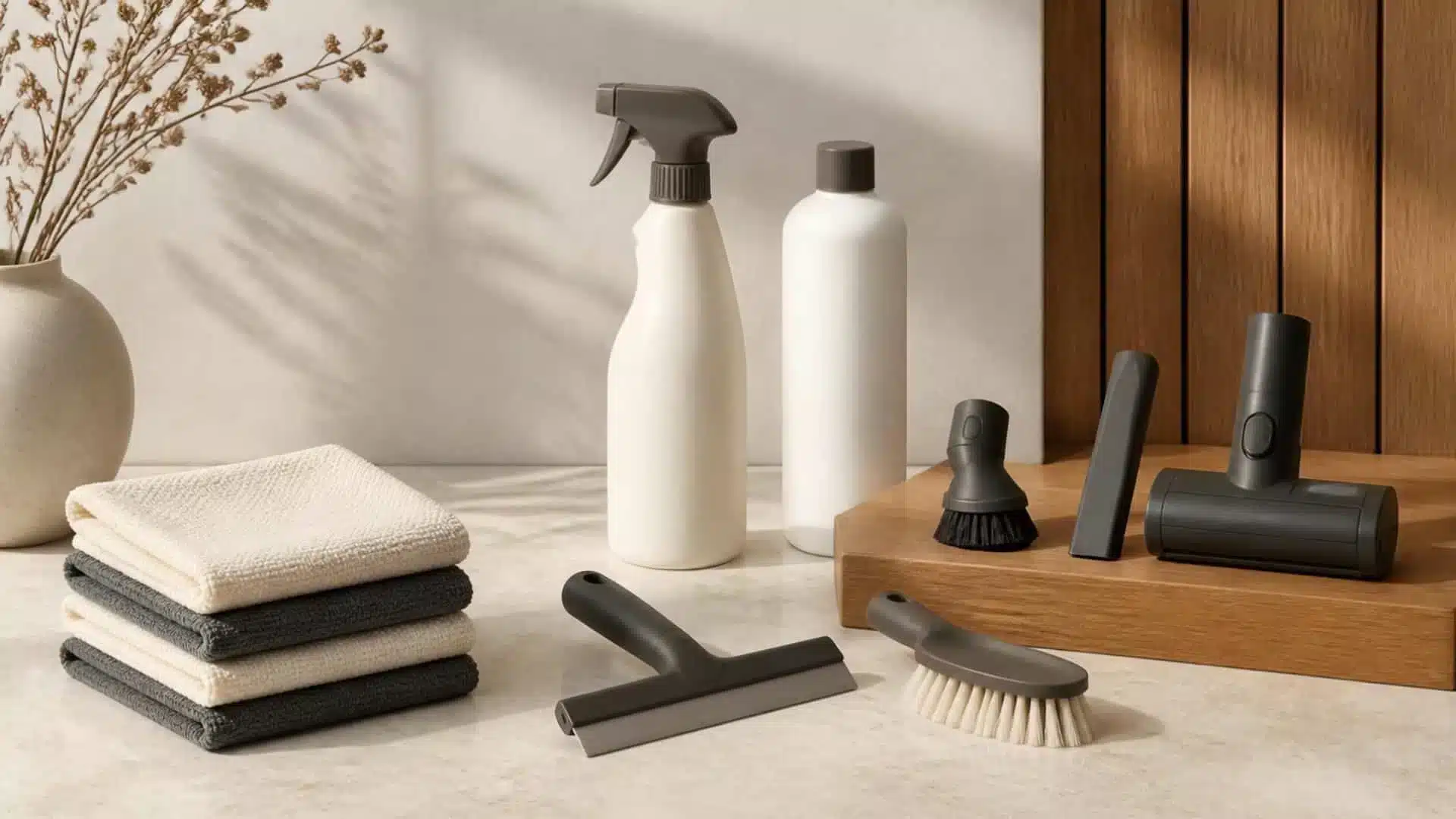
Good tools can reduce the amount of product you need. A microfibre or other suitable reusable cloth, a non-scratch brush, a squeegee and a vacuum with appropriate attachments often improve results more than adding another bottle.
- Reusable cloths: keep separate cloths for different jobs and launder them appropriately.
- Squeegee: useful for reducing water left on shower glass and tiles.
- Brushes: choose stiffness according to the surface so scrubbing does not cause damage.
- Vacuum tools: removing dry dust first often means less wet cleaning afterwards.
A Simple Room-by-Room Routine

| Area | Usually enough | Add only when needed |
|---|---|---|
| Kitchen | Everyday cleaner + washing-up/dishwasher detergent | Degreaser, oven cleaner |
| Bathroom | Everyday cleaner + limescale cleaner where needed | Mould remover, disinfectant for defined tasks |
| Living areas | Dust removal + compatible multi-surface cleaner | Wood or specialist finish care |
| Bedrooms | Dust removal + compatible multi-surface cleaner | Usually little else |
| Laundry | Laundry detergent | Stain treatment or specialist fabric product |
The principle is simple: organise products by cleaning problem, not by the marketing category printed on the front of the bottle.
When You Need a Disinfectant
Cleaning removes dirt, grease and residues. Disinfection is a separate process intended to reduce or inactivate microorganisms under defined conditions.
Most routine household surfaces do not need to be disinfected every time they are wiped. Where disinfection is appropriate, use a product intended for that purpose and follow its instructions, including any stated contact time.
Do not mix disinfectants or other household cleaners. In particular, never combine bleach products with acidic cleaners or ammonia-containing products because hazardous gases can be released.
Do Not Ignore Surface Care Instructions
A cleaner that works well on ceramic may be wrong for marble. A product that is fine on sealed laminate may be inappropriate for untreated timber. Manufacturer care instructions should take priority over generic cleaning advice.
This is also part of a lower-waste approach. Damaging a worktop, floor or tap finish because the cleaner was too acidic, abrasive or solvent-heavy creates far more waste than using a slightly more specialised product where it is genuinely required.
Use the Right Dose
Household cleaning products are often used by habit rather than measurement. More spray, more detergent or more concentrate does not necessarily mean a cleaner result.
- Follow dilution instructions for concentrates.
- Use laundry detergent according to load, soil and water hardness.
- Apply ready-to-use sprays only where product is needed.
- Respect contact times rather than simply using more product.
Correct dosing can make a standard bottle last longer and makes cost-per-use comparisons more meaningful.
Refills and Concentrates
Refill and concentrate systems can simplify a household routine when they replace repeat purchases rather than adding another layer of products.
Look at the amount of ready-to-use cleaner produced, the packaging per use, whether the reusable container is durable and whether the refill will still be easy to buy six months from now.
Our eco friendly cleaning products guide covers concentrates, recycled-content claims, refill systems and certifications in more detail.
Store Products Properly
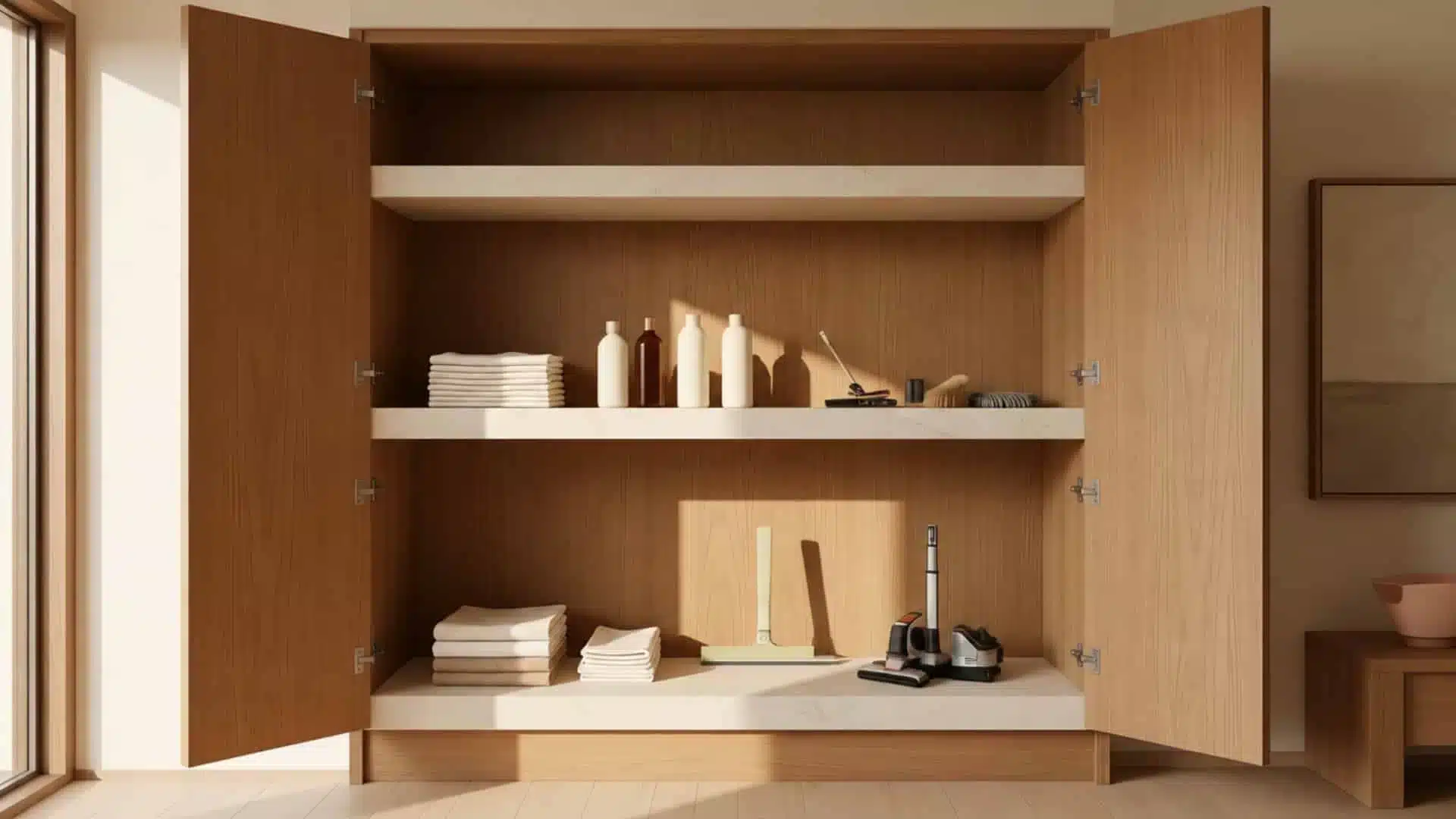
Keep household cleaning products in their original or clearly designated containers, securely closed and away from children and pets. Avoid decanting cleaners into drink bottles or unlabelled containers.
Separate incompatible products where the label instructs you to do so, and follow the manufacturer’s storage directions. Good storage also makes it easier to see what you already own before buying more.
Common Cleaning-Cupboard Mistakes
- Buying one cleaner per room. The same compatible product may work across several rooms.
- Keeping multiple near-identical sprays open at once.
- Using specialist cleaner for routine soil.
- Assuming stronger means better.
- Over-dosing concentrates or laundry products.
- Ignoring surface compatibility.
- Mixing cleaners.
- Replacing usable products only to switch immediately to a greener-looking alternative.
A Minimal Household Cleaning Checklist
- Everyday multi-surface cleaner for compatible sealed hard surfaces.
- Washing-up liquid or dishwasher detergent according to how you wash dishes.
- Laundry detergent.
- Bathroom/limescale cleaner if hard water or mineral deposits make it necessary.
- Degreaser only if your kitchen routinely needs more than the everyday cleaner can provide.
- One or two specialist products for surfaces or tasks that genuinely require them.
- Reusable cloths, brush and squeegee matched to the surfaces in your home.
Frequently Asked Questions About Household Cleaning Products
What household cleaning products do I actually need?
Most homes can start with an everyday multi-surface cleaner, dishwashing detergent, laundry detergent and—where needed—a bathroom/limescale cleaner. Add a degreaser or specialist product only when a recurring task genuinely requires one.
Do I need a separate cleaner for every room?
No. Many compatible sealed hard surfaces can be maintained with the same everyday cleaner. Separate products are more useful when the cleaning chemistry or surface-care requirement is genuinely different.
Do I need a glass cleaner?
Not necessarily. If a compatible everyday cleaner gives a clear, low-residue result on mirrors and glass, a separate bottle may be unnecessary. Technique and a clean lint-free cloth can make a significant difference.
Is a disinfectant an essential household cleaner?
Not for every routine cleaning task. Use a disinfectant where there is a defined hygiene need, and follow the product instructions and stated contact time.
Are refill cleaning products worth it?
They can be when the refill materially reduces packaging, the original container is durable, the system is easy to dose and refills remain reliably available.
Should I replace all my current cleaners with eco products?
Usually not all at once. If an existing product is suitable and safe to keep using, finishing it responsibly before replacing it can avoid unnecessary waste. Review each category when it genuinely needs repurchasing.
Build Around Jobs, Not Rooms
A simple cleaning routine comes from understanding what the products do. One everyday cleaner can cover many compatible surfaces. Limescale, heavy grease, laundry and dishwashing are different enough to justify their own formulations. Specialist products belong in the cupboard only when the task or surface truly requires them.
Build the routine around those jobs, use the correct dose and finish what you already own before adding something new. The result is a smaller, easier-to-manage cleaning cupboard without sacrificing the products that genuinely make home care easier.

Leave a Reply