

SUSTAINABLE HOME · CONSCIOUS CONSUMPTION
Second Hand Dining Table: What to Check Before You Buy
A practical buying guide for second hand dining tables—how to check room fit, seating clearance, structure, warping, extension mechanisms, surface condition, repair costs and transport before you commit.
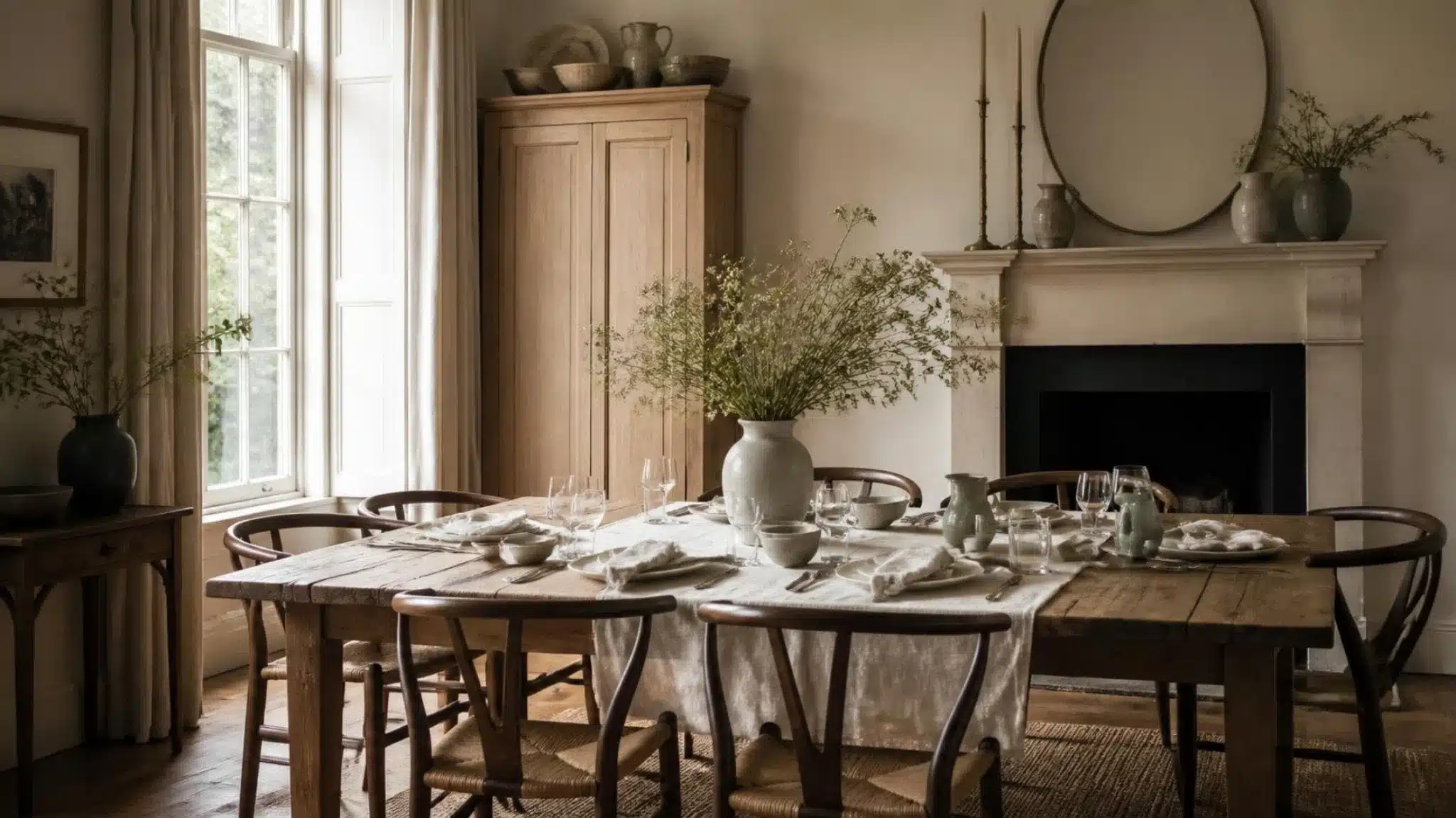
A second hand dining table can be an excellent place to buy pre-owned. Tables are easy to inspect compared with upholstered furniture, solid construction can last for decades, and surface marks often matter less than stability and proportion.
The main risk is buying with your eyes before checking the practical details. A table can look beautiful online and still be too large for the room, awkward for chairs, warped across the top or difficult to move through the doorway.
For the broader inspection framework—materials, pests, repairs, seller questions and transport—read our second hand furniture guide. For the wider circular-living approach, see our zero waste lifestyle guide.
Measure the Room Before the Table

Start with the room, not the listing. Measure the maximum footprint the table can occupy while leaving space for chairs to pull back and for people to move around comfortably.
- Measure the available length and width.
- Mark the proposed footprint on the floor with masking tape if the room is difficult to judge.
- Check doors, radiators, sideboards and circulation routes.
- For an extendable table, measure both closed and fully extended positions.
Do not assume that because a table physically fits, it will be comfortable to use. Dining furniture needs space around it as well as under it.
Check Seating and Circulation Clearance
A table that seats six in theory may only work for four in your room if chairs cannot be pulled out comfortably. Allow for occupied chairs, not just chair depth when they are tucked under the table.
If the table sits near a wall or sideboard, test how someone will actually sit down and stand up. In a through-route, leave enough clearance that other people do not have to squeeze behind occupied chairs.
Choose the Shape for the Space
Rectangular tables suit many dining rooms and make good use of longer spaces. Round tables can improve circulation in compact rooms and remove sharp corners from busy routes. Oval tables soften the footprint while retaining useful length.
Square tables work well in balanced rooms but can become awkward as they grow because the centre becomes harder to reach. Choose the shape for how the room works rather than because the listing photographs are attractive.
Identify the Material and Construction
Ask whether the table is solid timber, veneered board, plywood, MDF, metal, stone or a combination. Construction affects weight, repair options and how much refinishing is realistic.
Solid timber can often tolerate more extensive repair and refinishing. Veneer can be durable and attractive but needs gentler treatment. Manufactured board can work perfectly well when dry and structurally intact, but swelling from water damage is usually difficult to reverse.
Test Stability and the Base
Place both hands on the top and gently test for movement. A small amount of wobble may come from loose hardware or an uneven floor, but significant movement can indicate failed joints or a damaged base.
- Check each leg for splits and movement.
- Inspect trestles, pedestals and cross-braces.
- Look underneath for loose bolts, replacement screws or failed glue.
- Make sure the top is securely attached to the base.
- For pedestal tables, test for rocking at the outer edge of the top.
Inspect the Tabletop Carefully
A dining table top receives heat, water, food, cleaning products and daily wear. Small scratches or faded areas can be perfectly acceptable, especially if you like a lived-in finish.
Look more carefully for deep burns, black moisture staining, soft areas, large splits, loose veneer and previous repairs that have not held. Run your hand across the surface to detect ridges or lifting that photographs may hide.
Check for Warping and Twist
View the table from a low angle across the top. A gentle variation in older timber may be acceptable, but pronounced cupping or twist can affect glasses, plates and the way extension leaves meet.
Use a straight edge if the seller allows it, or compare the tabletop against door frames and other straight lines in the room. On an extendable table, check the centre seam and leaf alignment carefully.
Inspect Joints, Rails and Fixings
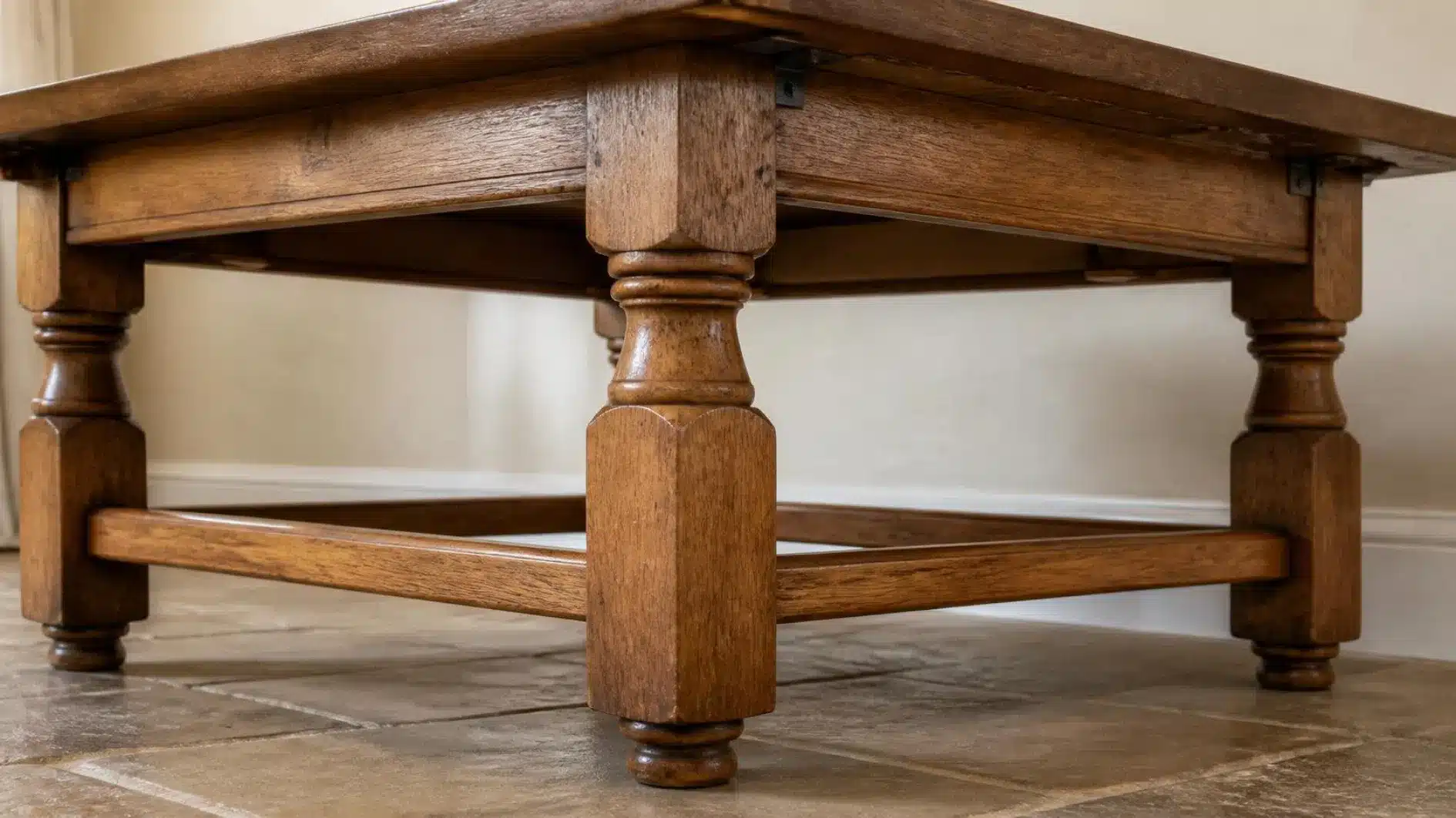
The apron or rails beneath the tabletop often reveal more about condition than the top itself. Look for cracks near leg joints, widening gaps, loose corner blocks and repeated screw repairs.
Original joints do not need to look pristine, but they should feel stable. A table that has been reinforced repeatedly without addressing the underlying joint can become a larger repair project than expected.
Test Extension Leaves and Mechanisms

If the table extends, operate the mechanism before buying. Ask the seller to show every leaf, clip, rail and support rather than assuming the system is complete.
- Make sure leaves are present and belong to the table.
- Check that the mechanism opens without excessive force.
- Confirm that extended sections sit level with the main top.
- Inspect stored leaves for colour difference, warping or damp.
- Check catches or clips that keep sections aligned.
A missing leaf can be difficult to replace accurately because thickness, timber movement, edge profile and finish all need to match.
Check Veneer Before Refinishing
Do not assume a marked tabletop can simply be sanded back. Many well-made dining tables use a timber veneer over a stable core.
Look at edges, underside details and damaged areas to understand the construction. If the top is veneered, aggressive sanding can cut through the decorative layer. Light restoration or professional refinishing may be more appropriate.
Assess Stains, Scratches and Finish Damage
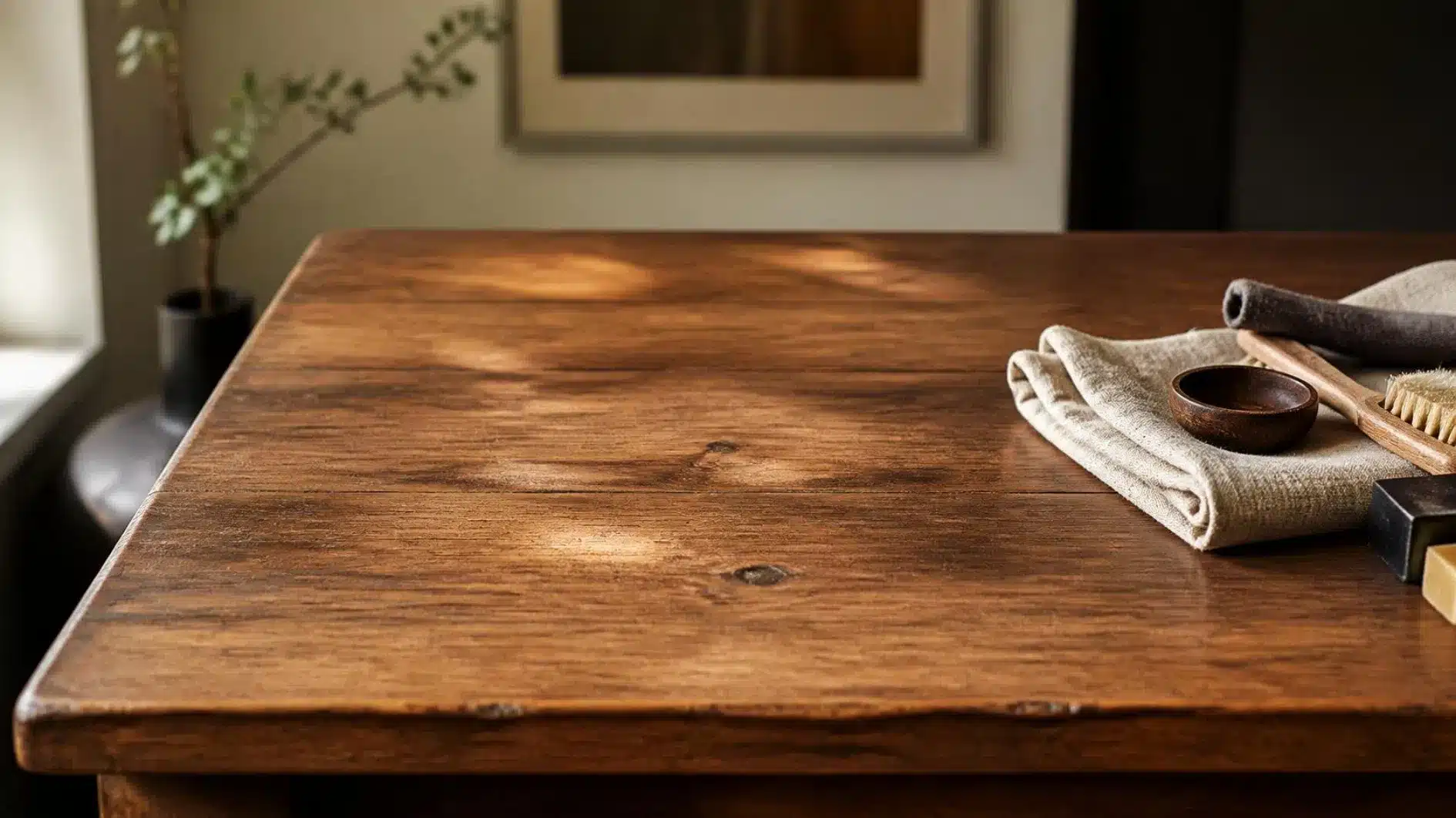
Separate cosmetic wear from damage that changes how the table performs. Fine scratches, faded polish and small dents can often be lived with. Deep water damage, lifting finish, sticky coatings or widespread heat marks deserve closer consideration.
Do not buy a table assuming every mark will disappear. If you like it only after an imagined full restoration, price that restoration before you commit.
Make Sure Your Chairs Will Work
Measure the clear space between the floor and the underside of the apron or tabletop. Armchairs may not slide under a low apron, and wide chair legs can conflict with table legs or pedestal supports.
If you already own dining chairs, measure their width and arm height before collection. A nominal six-seater can feel crowded if the table base occupies the same space as the chairs.
Estimate Repair and Refinishing Costs
A second hand dining table can still be good value with some work, but distinguish maintenance from restoration.
- Light work: cleaning, tightening hardware, waxing or touching up minor finish wear.
- Moderate work: regluing joints, repairing small veneer defects or refinishing a sound solid-timber top.
- More involved: correcting structural movement, replacing missing extension parts or professional refinishing.
Add those costs to delivery before deciding whether the table is genuinely better value than other options.
Plan Collection and Transport
Dining tables are often larger and heavier than they appear online. Confirm whether the legs, pedestal or top can be removed and what tools are needed.
- Measure the vehicle opening as well as the cargo area.
- Protect corners and the tabletop with blankets.
- Secure removable leaves separately.
- Keep fixings in a labelled bag during disassembly.
- Use enough people or professional delivery for heavy tops such as stone or thick solid timber.
Questions to Ask the Seller
- What are the exact dimensions closed and extended?
- What is the tabletop and base made from?
- Does it wobble or have any loose joints?
- Is the top warped, cracked or water damaged?
- Are all extension leaves, clips and fixings present?
- Has the table been refinished or repaired?
- Can the legs or base be removed for transport?
Ask for clear photographs of the underside, corners, leaf mechanism and any disclosed damage. Those images are often more useful than another styled photograph of the top.
Common Buying Mistakes
- Measuring the table but not chair clearance.
- Assuming “solid wood” from appearance alone.
- Ignoring movement because the surface looks attractive.
- Buying an extendable table without testing the mechanism.
- Planning to sand a veneered top aggressively.
- Forgetting to check whether existing chairs fit beneath the apron.
- Underestimating van hire, delivery or lifting.
- Buying a restoration project when you needed a table for immediate use.
Second Hand Dining Table Checklist
- Measure the room, doorway and access route.
- Check closed and extended dimensions.
- Allow room for occupied chairs and circulation.
- Confirm the tabletop and base materials.
- Test wobble, legs, pedestal and rails.
- Inspect the top for warping, splits, moisture and loose veneer.
- Operate every extension mechanism and fit every leaf.
- Check the underside for previous structural repairs.
- Confirm your chairs fit the apron and base.
- Add repair and transport costs before deciding on value.
Frequently Asked Questions About Second Hand Dining Tables
What should I check first on a second hand dining table?
Start with dimensions and stability. Make sure the table fits the room and access route, then check legs, joints, rails and the base before focusing on cosmetic surface marks.
Is a scratched dining table worth buying?
Often, yes. Light scratches and normal wear can be easier to live with or repair than structural damage. The important question is whether the table is sound and whether you are happy with the finish as it is or with a realistic restoration plan.
How do I know if a dining table is solid wood?
Inspect edges, underside surfaces and any existing damage for continuous grain and construction clues. Ask the seller directly, but verify where possible because veneered furniture can closely resemble solid timber.
Should I avoid veneer on a used dining table?
No. Veneer can be durable and well made. Check for lifting, bubbles, missing sections and water damage, and avoid assuming the top can be heavily sanded during refinishing.
Is an extendable second hand dining table a good idea?
It can be very practical if all leaves and fixings are present, the mechanism works smoothly and the extended top sits level. Test the complete system before buying.
Choose the Table You Can Actually Use
The best second hand dining table is not the one with the most character in the listing. It is the one that fits the room, gives chairs enough space, feels structurally sound and still makes financial sense after transport and repair are included.
Inspect the base as carefully as the top, test every extension and measure twice before collection. A dining table chosen that way can become a useful long-term piece rather than another short-lived bargain. To dress the table once it is home, explore our kitchen and dining pieces.

Leave a Reply