

NATURAL LIVING · INDOOR PLANTS & BIOPHILIC DESIGN
Indoor Tree Guide: Choosing the Right Statement Plant for Your Space
A practical guide to choosing an indoor tree for your home—judging light, mature size, growth habit, placement and care before a floor-standing plant becomes part of the room.

An indoor tree can change the scale of a room more decisively than almost any smaller houseplant. Once a plant becomes floor-standing, with a trunk, cane or strong central stem and a canopy above furniture height, it starts to behave like part of the architecture.
That visual impact is useful, but it also raises the stakes. An indoor tree that is too wide for the circulation route, too dark for the available light or too demanding for the room’s conditions can become difficult long before it becomes beautiful.
The right approach is to choose the room first and the plant second. Our broader indoor plants guide explains the core relationship between light, humidity, temperature and placement; this guide applies those principles specifically to indoor trees and other tall statement plants.
What Counts as an Indoor Tree?
The term indoor tree is more useful as a design description than a strict botanical category. Some indoor tree plants are genuine woody trees grown in containers; others are shrubs or tree-like tropical houseplants trained or allowed to develop a strong upright form.
What they share indoors is scale. They usually rise from the floor, occupy vertical space and create a canopy or mass of foliage above the height of smaller tabletop plants.
That makes their design role different. A small plant decorates a surface. A well-chosen indoor tree can anchor an entire corner, balance a tall window or introduce a living vertical element beside low furniture.
Why Indoor Trees Work So Well in Interiors
Indoor trees introduce height without adding another hard architectural object. Their trunks, branching structure and foliage soften walls and straight lines while preserving a sense of vertical order.
They are particularly useful in rooms with generous ceiling height, large windows or substantial furniture, where small plants can look visually under-scaled. One tree can also create a calmer composition than several small pots competing for attention.
This overlaps with the wider principles of biophilic design: living form, natural variation and changing light can help an interior feel more connected to nature without requiring dense planting.
Start With Light Before Species
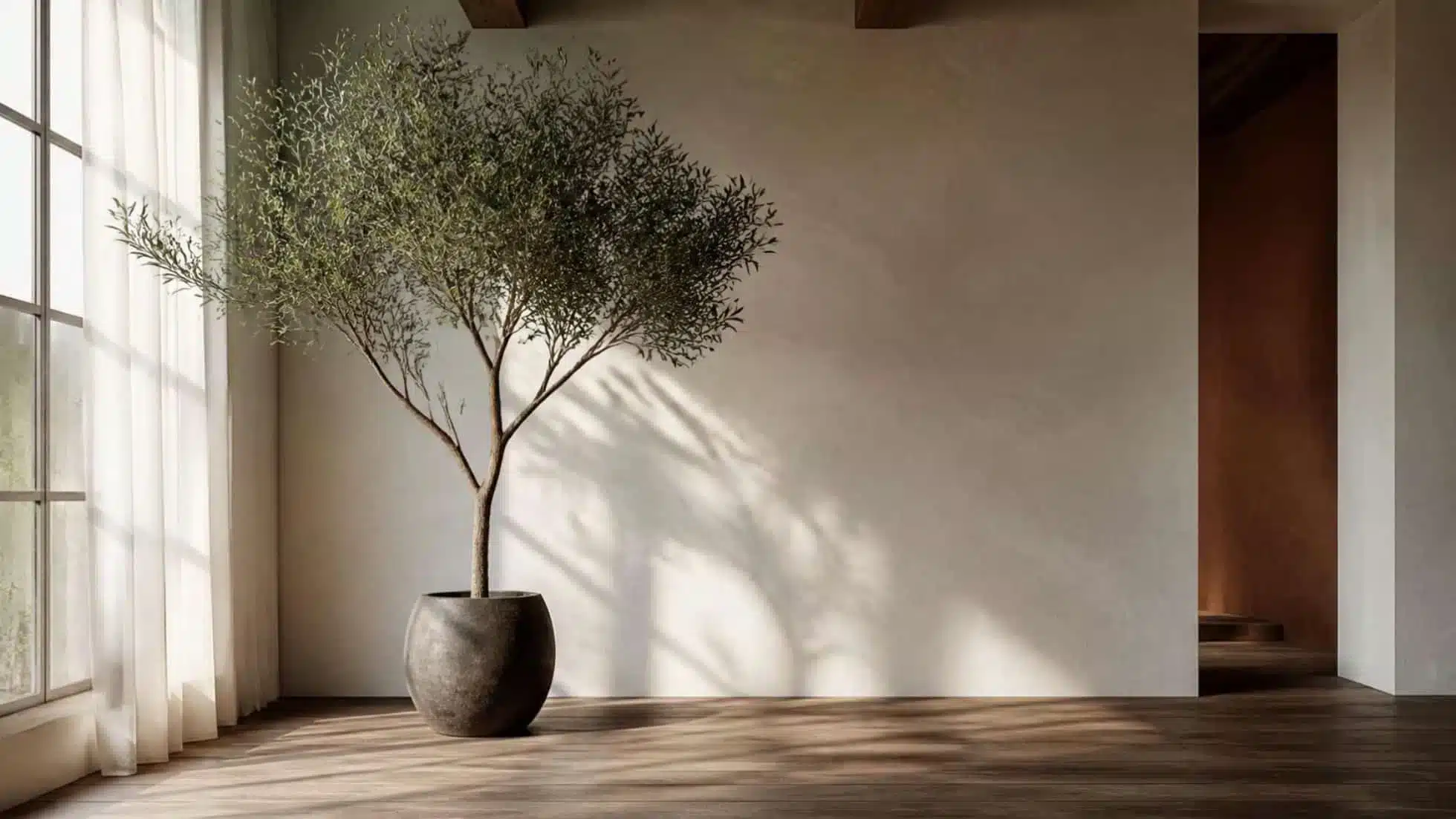
Before deciding which indoor tree you like, identify where it can actually grow.
The Royal Horticultural Society recommends selecting houseplants according to the conditions of their location, particularly light, humidity and temperature. Light also changes with distance from the window, orientation and season, so the same room can contain several very different growing environments. RHS
For a tall plant, this matters even more because moving it later can be difficult. A large decorative pot, wet compost and a mature canopy can make even a relatively light specimen awkward to reposition.
- Observe the intended position at different times of day.
- Check whether direct summer sun reaches the leaves.
- Notice radiators, draughts and cold glazing nearby.
- Allow for weaker winter light.
- Do not assume ordinary room lighting can replace natural daylight.
Measure Mature Size, Not Shop Size
The specimen in a garden centre is only its current size. Some indoor trees can continue growing for years in suitable conditions, and the width of the canopy is often more important than the initial height.
Measure the intended zone in three dimensions: height, mature spread and container footprint. Then allow extra clearance so leaves do not immediately press against walls, curtains, shelves or circulation routes.
If scale is your main concern, our guide to large indoor plants goes deeper into visual weight, furniture proportion and how to avoid overcrowding.
Choose the Growth Habit for the Room
Two indoor trees at the same height can behave very differently in an interior.
- Upright and narrow: useful where floor area is limited but ceiling height is available.
- Broad and branching: stronger as a statement plant, but needs more lateral clearance.
- Dense and leafy: creates visual mass and can feel heavier beside substantial furniture.
- Open and airy: preserves sightlines and can work better near windows or transitions between zones.
Choose the silhouette for the room rather than trying to prune a naturally broad plant into a permanently narrow shape.
Ficus: The Classic Indoor Tree Group

Ornamental figs are among the most established indoor tree plants. The RHS describes Ficus as a group of tender trees, shrubs and climbers that includes familiar houseplants such as the rubber plant and weeping fig. Some can reach several metres tall indoors when conditions suit them. RHS
Ficus elastica, often searched for as a rubber tree indoor plant, is valued for its broad, leathery leaves and strong vertical presence. The RHS recommends bright filtered or indirect light, moderate watering during active growth and sparing water in winter. RHS
The important point is not that every Ficus behaves identically. It is that this group offers several genuinely tree-like houseplants whose mature form can suit a floor-standing interior role.
Indoor Olive Trees Need More Light Than Their Styling Suggests
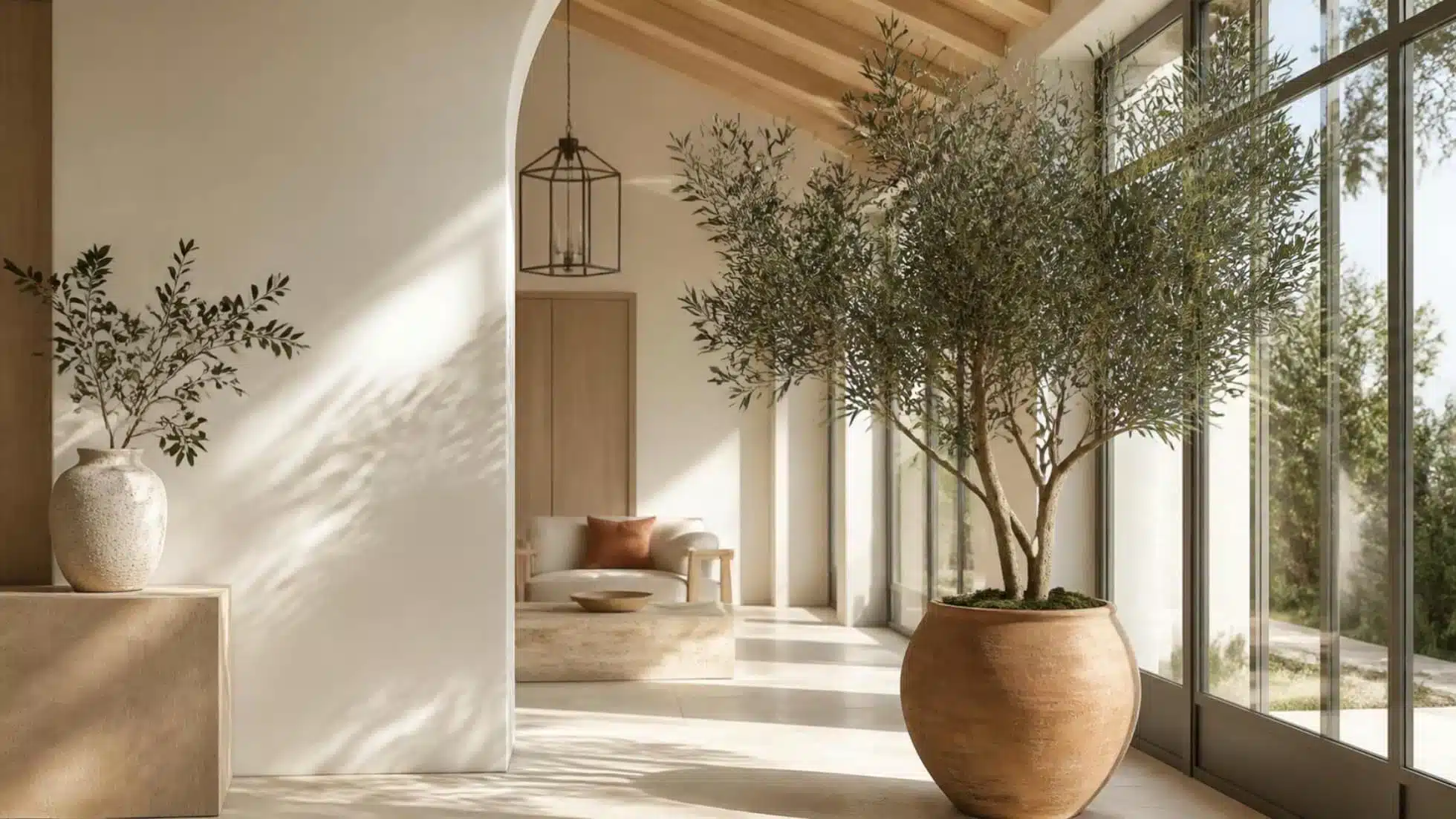
The indoor olive tree is popular because its silvery foliage and open branching structure suit restrained interiors. But an olive should not be chosen simply because it photographs well indoors.
Olives are Mediterranean trees that prefer full sun and sharply drained conditions. The RHS advises full light when they are grown under glass. They are also well suited to container culture, which allows them to be moved when necessary. RHS
In practical terms, a bright conservatory, glazed space or genuinely sunny position is more appropriate than a dim living-room corner. If your room cannot provide the light the plant requires, choose a tree-form houseplant that is better adapted to indoor conditions.
Indoor Lemon Trees and Other Citrus Need Specialist Conditions
Searches for an indoor lemon tree are common, but citrus is a good example of why the phrase “indoor tree” can be misleading.
The RHS notes that citrus does not make an ideal long-term houseplant in a typical centrally heated room. It generally prefers plenty of light, higher humidity and a cooler winter period, making a conservatory, greenhouse or glazed porch more suitable for many plants. RHS
If you want the visual effect of a small fruiting tree indoors, first decide whether you can provide those conditions. A warm, dry room with limited winter light may be much easier for a Ficus than for a citrus tree.
Palms and Other Tree-Like Houseplants
Not every plant used as an indoor tree is botanically a tree. Palms and cane-forming houseplants can still provide the same design function: height, vertical rhythm and foliage above furniture level.
The useful distinction is therefore not “tree versus non-tree” but whether the plant’s growing requirements and mature silhouette suit the room. An indoor palm tree may feel visually lighter than a broad-leaved Ficus of the same height, while several canes may create more density at floor level than a single trunk.
Choose the growth habit that supports the room’s proportions and circulation, then confirm the exact species can tolerate the light, humidity and temperature available.
Where to Place an Indoor Tree
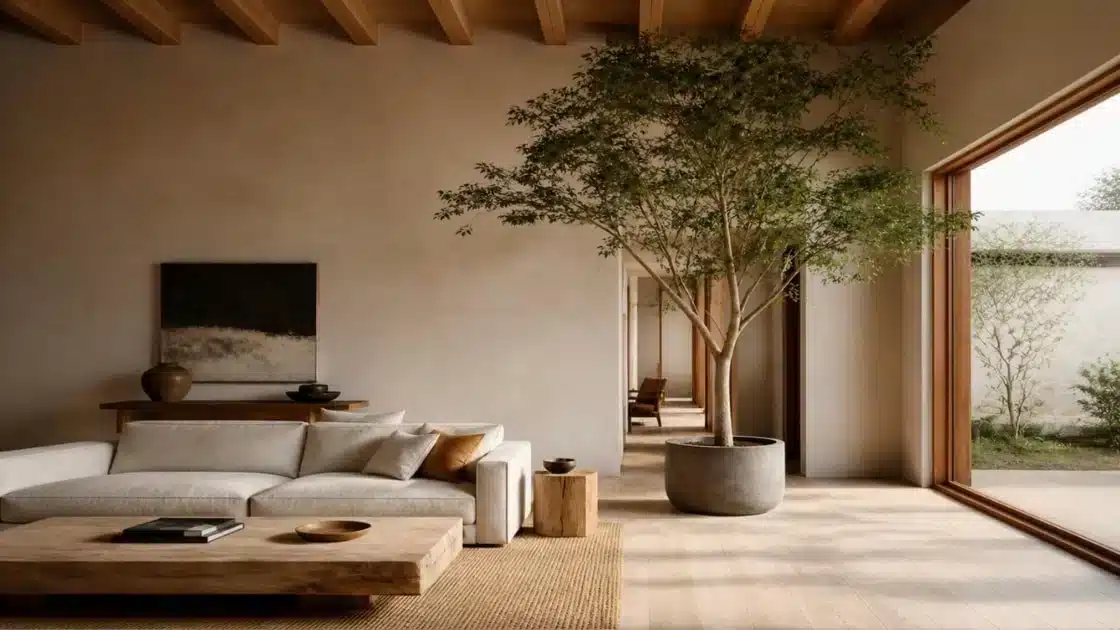
An indoor tree works best where horticultural conditions and spatial composition overlap.
Beside a bright window
This is often the most practical position for light-hungry tree-form houseplants, provided foliage is not pressed against glazing or exposed to damaging summer sun.
At the end of a furniture group
A tall plant can visually finish a sofa or seating arrangement without requiring another cabinet, lamp or decorative object.
In an architectural corner
This can work when the corner receives enough light and the mature canopy has room to project into the space without blocking movement.
Near a transition between zones
An open, tree-like form can create a soft visual marker between dining and living areas while preserving sightlines.
Plan the Container and Floor Area Together
The planter is part of the composition and part of the horticulture. A large outer pot adds visual weight and floor area, while the practical inner container must still support drainage and root health.
Avoid moving a plant into an excessively large pot simply because the decorative scale looks right. Root systems generally benefit from gradual increases in container size rather than a dramatic jump that leaves a large volume of wet growing medium around relatively few roots.
Also consider the floor itself. Water, condensation and heavy containers can damage timber or delicate finishes. Protect the surface and make sure the tree can still be moved for cleaning, repotting or seasonal adjustment.
Watering and Maintenance at Tree Scale
A larger plant does not automatically need more frequent watering. Water demand depends on species, light, room temperature, humidity, root volume, container size and growing medium.
The RHS recommends checking the actual moisture in the compost rather than watering houseplants to a rigid calendar. The plant should also be placed where you can comfortably reach the pot, inspect leaves and clean around it. RHS
Large leaves collect dust, and tall specimens can be difficult to rotate evenly. Maintenance access should therefore be part of the original placement decision, not an afterthought.
Common Indoor Tree Mistakes
- Choosing by photograph rather than conditions. A plant styled beautifully in a bright studio may not suit your room.
- Ignoring mature width. Canopy spread often causes problems before height does.
- Treating every “indoor tree” as a permanent houseplant. Citrus and olives can have very different requirements from tropical foliage plants.
- Blocking windows or circulation. A statement plant should support the room, not obstruct it.
- Overpotting for visual effect. Decorative scale and root requirements are not the same thing.
- Placing the tree where maintenance is awkward. If you cannot reach the pot easily, care will become inconsistent.
A Simple Indoor Tree Selection Method
- Choose the exact location.
- Assess the light through the day and across the season.
- Measure available height, mature width and pot footprint.
- Decide whether the room needs an upright, open or broad form.
- Research the actual species rather than relying on the label “indoor tree”.
- Check temperature, humidity and watering requirements.
- Plan how you will move, rotate and repot it later.
- Only then choose the individual specimen and planter.
Frequently Asked Questions About Indoor Trees
What is the easiest indoor tree for a living room?
There is no single easiest choice because living-room conditions vary. Start with the light, temperature and humidity of the exact position. Ficus species are widely grown as houseplants, but the right choice still depends on the room. If you’re deciding where a statement plant should sit alongside sofas, windows and other furniture, our guide to plants for the living room covers placement and visual balance in more detail.
Can an olive tree live indoors?
An olive can be grown under glass or kept in a bright protected space, but it needs strong light and is better treated as a sun-loving Mediterranean tree than as a generic low-maintenance houseplant.
Can a lemon tree grow indoors?
Citrus can spend part of the year indoors, but typical centrally heated rooms are not ideal long term. A bright conservatory, greenhouse or glazed porch is often more suitable because citrus benefits from high light, humidity and cooler winter conditions.
How close should an indoor tree be to a window?
There is no universal distance. Window orientation, season, glazing, outside shade and species all matter. Assess the light at the exact position rather than relying on a fixed measurement.
How do I stop an indoor tree making the room feel crowded?
Choose a growth habit that matches the available space, preserve circulation and leave visible breathing room around the canopy. One strong tree often needs fewer decorative objects around it.
Choose Presence Without Losing Practicality
The best indoor tree is not simply the tallest or most dramatic specimen you can fit through the door.
It is the plant whose light requirements, mature form, container, maintenance needs and visual weight all make sense in the room you actually have.
Choose conditions first, silhouette second and species third. When those three decisions align, an indoor tree can add height, softness and architectural presence without becoming an obstacle or a short-lived styling exercise.

Leave a Reply