

NATURAL LIVING · INDOOR PLANTS & BIOPHILIC DESIGN
Indoor Plants: A Practical Guide to Choosing Plants for Your Home
A practical guide to choosing indoor plants for the light, space and conditions you actually have—from small tabletop plants to statement greenery and indoor trees.
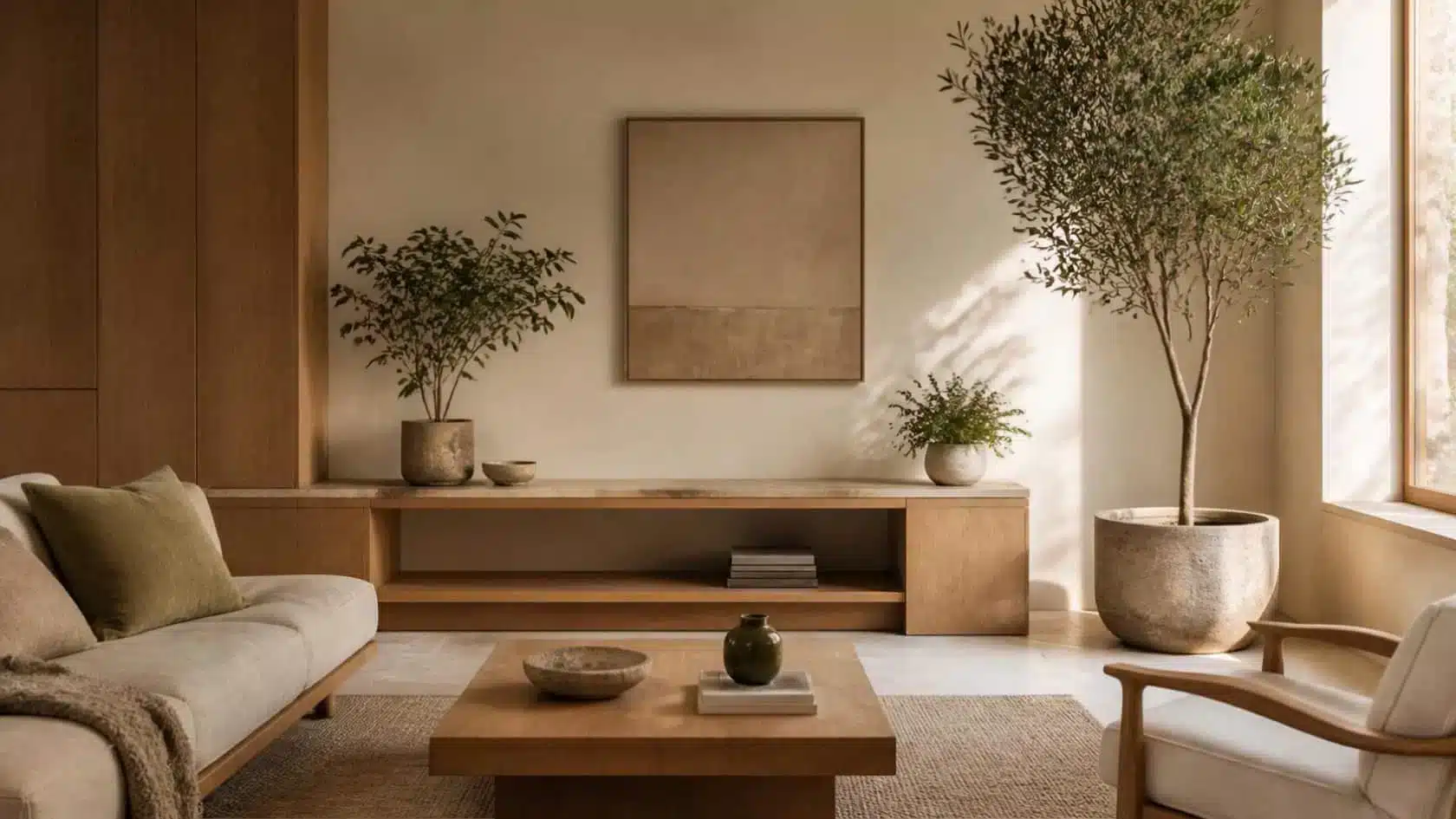
Indoor plants can completely change the character of a room. A single sculptural plant can soften an architectural corner; a trailing plant can bring movement to a shelf; several smaller plants can make a space feel layered and lived in.
But choosing plants successfully involves more than finding foliage that looks good beside the sofa.
The most useful question is not:
“Which indoor plant do I like?”
It is:
“Which plant suits the conditions of this room?”
The best indoor plants for a room are those that match its light, temperature, humidity, available space and the amount of care you are realistically willing to provide. The Royal Horticultural Society recommends choosing houseplants according to their location because conditions can vary considerably between rooms and throughout the year. RHS
This guide explains how to choose indoor plants systematically, position them thoughtfully, care for them without overcomplicating things and use greenery as part of a calmer, more considered interior.
What Are Indoor Plants?
Indoor plants, often called house plants or houseplants, are plants grown inside homes or other buildings rather than permanently outdoors.
Many popular houseplants originate from climates where warmth allows them to grow year-round. A heated home can reproduce parts of those conditions, but every room creates its own miniature growing environment.
A bright south-facing room may receive intense summer sun.
A north-facing hallway may remain comparatively dim.
A bathroom may provide naturally higher humidity.
A centrally heated living room can become very dry during winter.
That is why the phrase “indoor plant” does not describe one set of growing requirements. Different species can need very different conditions.
The RHS identifies light, humidity and temperature as three of the main considerations when selecting a houseplant for a particular location. RHS
A useful way to think about indoor planting is therefore:
Choose for the room first. Style the room with the plant second.
When those two considerations work together, plants are more likely to thrive and the finished interior tends to look more natural.
Why Indoor Plants Work So Well in Interiors
Plants introduce something furniture and decorative objects cannot quite replicate: living form.
Leaves are irregular. Stems change direction. New growth develops over time. Light passes through foliage differently throughout the day.
That makes plants particularly useful in interiors built around restrained materials such as plaster, timber, linen, ceramic and stone.
They can provide:
- organic shape against straight architectural lines
- colour without introducing a strong artificial palette
- height in an otherwise low room
- movement through trailing or arching foliage
- visual connection between indoor and outdoor environments
- seasonal change within a relatively static interior
This is also why plants feature so prominently in biophilic design, a broader approach to incorporating nature and natural references into built environments.
For Lumen Larch, the most useful approach is not to turn every room into an indoor jungle. It is to think about plants as you would lighting or furniture: placement, proportion and repetition matter.
Start With the Room, Not the Plant
Before buying anything, assess the room.
A simple five-part framework works well:
| Question | What to assess |
|---|---|
| Light | How much natural daylight reaches the location? |
| Temperature | Is it consistently warm, cool, draughty or close to heating? |
| Humidity | Is the room naturally humid or dry? |
| Space | How large can the plant realistically become? |
| Care | How much maintenance will you consistently provide? |
This prevents one of the most common mistakes in houseplant ownership: choosing a plant entirely for appearance and then trying to force it to survive in an unsuitable location.
The RHS specifically warns against positioning plants purely for decorative reasons without considering their growing needs. RHS
Understanding Light for Indoor Plants

Light is usually the first condition to assess.
The difficulty is that descriptions such as bright, indirect, low light and full sun can sound more precise than they really are.
Indoor light changes according to:
- window orientation
- distance from the window
- neighbouring buildings
- trees and outdoor shading
- blinds and curtains
- season
- cloud cover
- room depth
A position that is bright in July may receive relatively little useful daylight in December.
Direct light
Direct sunlight reaches the leaves without being substantially filtered.
Some plants tolerate or enjoy direct sun, but many popular foliage plants can scorch if suddenly exposed to strong summer sunlight through glass.
The RHS notes that strong summer sun can damage susceptible houseplants, while that same position can be useful during winter when sunlight is weaker. RHS
Bright indirect light
This is one of the most commonly recommended conditions for tropical foliage plants.
The room feels bright, but strong direct sun does not sit on the foliage for long periods.
Locations near windows with filtered light often fall into this category.
Lower light
A lower-light position still receives natural daylight.
It does not mean complete darkness.
Even plants commonly sold as “low-light plants” still require light for growth. The RHS notes that no houseplant can tolerate a permanently windowless, completely dark position. RHS
This distinction matters when planning plants for:
- hallways
- bathrooms without windows
- deep shelves
- dark corners
- rooms with very small windows
If there is essentially no natural light, decorative artificial greenery may actually be a more honest design choice than repeatedly replacing struggling live plants.
A Simple Way to Assess Your Room
Stand where you plan to place the plant during the daytime.
Ask:
Can I clearly see natural daylight reaching this location without switching on a lamp?
Then observe the same spot at different points in the day.
A plant positioned three metres from a window can experience dramatically different conditions from one placed directly beside it—even though both are technically in the same room.
Domestic decorative lighting should also not automatically be treated as plant lighting. The RHS notes that ordinary household lighting is generally not suitable for supporting plant growth; dedicated grow lighting is different. RHS
Choosing Indoor Plants by Room

Rather than thinking only in terms of species, think in terms of room conditions.
Living room
Living rooms often offer the greatest flexibility because they may contain several different light zones. For a room-specific approach, see our guide to arranging living room plants around windows, furniture and circulation.
You might use:
- one larger floor plant near a bright window
- a medium plant on a console
- trailing foliage on a shelf
- smaller plants grouped near natural light
The room’s size matters as much as the plant.
A tiny plant on a large empty wall can feel accidental. A very large plant squeezed between furniture can feel intrusive.
The goal is proportion.
Bedroom
Bedrooms often suit quieter, simpler planting schemes. For a room-specific approach, see our guide to the best plants for bedroom spaces.
Rather than filling every surface, consider:
- one plant on a chest of drawers
- a taller plant in an unused corner
- a small plant near a sufficiently bright window
- restrained greenery alongside natural textiles
Do not choose bedroom plants on the basis of exaggerated claims about “purifying” the air or transforming sleep quality.
Choose them because the growing conditions work and because you enjoy living with them.
Bathroom
Bathrooms can provide increased humidity, which may suit plants that prefer more humid conditions.
However, humidity cannot compensate for inadequate light.
A windowless bathroom is still a difficult environment for a live plant.
The RHS notes that bathrooms often have higher humidity than living rooms, while centrally heated living spaces can be much drier. RHS
Kitchen
Kitchens can offer useful natural light and somewhat higher humidity, but conditions vary.
Keep plants away from:
- direct heat
- cooker splash zones
- frequently opened external doors in winter
- places where foliage obstructs food-preparation areas
A small grouping of plants can work especially well near a bright window if there is enough practical surface space.
Hallway
Hallways are often more difficult because they may combine:
- lower light
- cooler temperatures
- draughts
- frequent movement
The RHS identifies hallways as potentially challenging because temperatures can fluctuate and draughts may be present. RHS
Choose carefully rather than treating “low light” as permission to put any houseplant there.
Think About Plant Form, Not Just Species

A useful interior-design approach is to classify indoor plants according to shape and function.
Tabletop plants
These work well on:
- desks
- shelves
- consoles
- side tables
- kitchen surfaces
- bedside furniture
They are useful where the room needs a small amount of organic form rather than a dramatic focal point.
Trailing plants
Trailing plants introduce downward movement and work particularly well on:
- higher shelves
- cabinetry
- wall-mounted storage
- bookcases
Avoid placing them where long stems will constantly be knocked or need to be moved.
Upright plants
Plants with vertical growth are useful for narrow floor areas.
They can help balance:
- tall shelving
- floor lamps
- doorways
- vertical artwork
Broad or spreading plants
These create more visual volume.
Give them enough clearance from walls, furniture and walkways.
Large indoor plants and indoor trees
Large plants create immediate architectural impact, but they should not be bought purely because they look impressive in photographs. For tree-form options, see our indoor tree guide.
Before buying one, check:
- mature width
- mature height
- light requirement
- container size
- weight once watered
- access for repotting
- whether you can move it if seasonal conditions change
The Lumen Larch Three-Layer Planting Framework
For a room that needs more than one plant, use three visual layers.
Layer 1: The anchor
This is the largest plant.
It might sit:
- beside a window
- near a chair
- at the end of a console
- in an otherwise empty corner
Its job is to establish the main organic form.
Layer 2: The middle layer
Add one or two medium plants at furniture height.
This connects the large plant visually to the rest of the room.
Layer 3: The detail
Use one or two smaller or trailing plants.
These should feel like finishing details rather than clutter.
You do not need all three layers in every room.
A small bedroom may need only one well-positioned plant. A large living room might benefit from the full structure.
The purpose of the framework is to avoid the common pattern of scattering many unrelated small plants around every available surface.
Watering Indoor Plants Without a Rigid Schedule
One of the simplest improvements you can make to plant care is to stop assuming every plant should be watered on a fixed weekly schedule.
Water demand changes according to:
- species
- pot size
- temperature
- season
- light
- humidity
- plant size
- growing medium
The RHS recommends checking the moisture in the growing medium and watering when necessary rather than automatically watering at fixed intervals. RHS
That makes much more sense than a rule such as:
“Water every Sunday.”
A plant may dry rapidly during a bright summer week and much more slowly during winter.
Drainage matters
Containers should allow excess water to escape.
The RHS recommends drainage holes because saturated growing media can contribute to root problems. RHS
If you use a decorative outer pot, keep the plant in an appropriate inner nursery pot or another container that allows drainage, then empty accumulated water rather than leaving the root system permanently submerged.
Humidity and Central Heating
Many indoor plants originate from more humid environments than a centrally heated UK home provides.
Humidity can also vary significantly within the same property.
Bathrooms and kitchens may be relatively humid.
Living rooms can become dry when heating is running.
Plants that need higher humidity may struggle if positioned directly beside:
- radiators
- heating vents
- fireplaces
- persistent warm draughts
The solution is not necessarily to mist every plant continually.
Start by choosing plants suited to the room you already have.
That is usually more sustainable than repeatedly trying to modify an unsuitable environment.
Temperature and Draughts
Indoor temperature is not always as stable as it feels to us.
Potential problem areas include:
- immediately beside external doors
- conservatories in winter
- windowsills at night
- directly above radiators
- rooms that are rarely heated
- hot south-facing windows in summer
Research the individual plant’s temperature tolerance before buying it.
The RHS recommends considering daily and seasonal temperature changes when positioning houseplants. RHS
Choosing the Right Pot

A plant pot plays two roles:
horticultural container and interior object.
Those roles should work together.
Materials such as ceramic, terracotta, stoneware and restrained neutral finishes can integrate naturally with the Lumen Larch aesthetic, but appearance should not override drainage and appropriate sizing.
Avoid immediately placing a small plant into an enormous pot.
Overpotting leaves a large volume of growing medium around a relatively small root system, which can stay wet for too long. The RHS recommends moving plants into appropriately sized containers rather than dramatically oversized ones. RHS
Repot when there is a reason
Signs that repotting may be appropriate include roots becoming heavily congested or growing through drainage holes.
Container plants generally benefit from periodic repotting or refreshing of the growing medium, but the timing depends on plant vigour, root development and the condition of the compost. RHS
Do not automatically repot a healthy new plant merely because you bought a decorative pot.
Indoor Plants and Biophilic Design

Biophilic design goes beyond adding plants.
It is about strengthening connections between the built environment and natural systems.
That can include:
- daylight
- natural materials
- views outside
- vegetation
- organic shapes
- variation in texture
- natural colour
- spatial relationships that feel connected to landscape or shelter
Indoor plants are therefore one part of a much wider design vocabulary.
A plant beside a timber chair, linen curtain and window with natural daylight may feel more integrated than ten plants placed randomly in a room dominated by unrelated materials.
How to Style Plants Without Creating Visual Clutter
More greenery is not automatically better.
One of the most useful design principles is repetition with variation.
For example, rather than six completely different planters, you might use:
- similar warm ceramic finishes
- different heights
- related shapes
- repeated timber or stone tones
The plants themselves provide variation.
The containers provide continuity.
Leave breathing space
Plants need visual space just as furniture does.
A sculptural plant often looks stronger against a quiet wall than among many decorative objects.
Consider silhouette
Look at the outline of the foliage from across the room.
Does it:
- balance the furniture?
- obscure artwork?
- interfere with a lamp?
- block circulation?
- disappear against a busy background?
A plant should contribute to the composition rather than merely occupy unused floor space.
Large Indoor Plants: Scale Before Impact
For a focused guide to proportion, placement and maintenance, read our guide to large indoor plants.
Large indoor plants are tempting because they can instantly make a room feel finished.
But scale should be evaluated carefully.
Before buying, measure:
height × width × container footprint
Then mark that area temporarily in the room.
A plant that looks modest in a nursery can feel enormous once placed beside residential furniture.
Also consider access.
Will you be able to:
- carry it through the doorway?
- rotate it?
- water it?
- clean around it?
- repot it later?
- move it away from a cold window in winter?
A successful statement plant should feel architectural, not inconvenient.
Green Walls and Vertical Planting
A green wall or vertical garden can introduce planting where floor area is limited, but it is a much more involved system than placing several plants on shelving.
You need to consider:
- light across the entire installation
- irrigation
- drainage
- access for maintenance
- plant compatibility
- wall protection
- long-term replacement
A small vertical arrangement may be manageable in a home, while a large living wall is closer to a horticultural installation than ordinary interior decoration.
Do Indoor Plants Clean the Air?
This claim needs careful handling.
Laboratory experiments have shown that plants can remove some airborne volatile organic compounds under controlled chamber conditions. However, that does not mean a few houseplants meaningfully clean the air in an ordinary home.
A review published in the Journal of Exposure Science & Environmental Epidemiology analysed previous chamber studies and concluded that normal potted plants would need to be present at extremely high densities to match the pollutant removal already achieved through typical building air exchange. PubMed
So choose indoor plants because you enjoy:
- their form
- their colour
- their changing growth
- the process of caring for them
- the way they contribute to an interior
Do not buy them as substitutes for ventilation or appropriate indoor-air-quality measures.
This distinction is particularly important for Lumen Larch because we should avoid turning lifestyle content into unsupported health claims.
Indoor Plants in Homes With Pets
If cats, dogs or other animals can access your plants, toxicity should be part of the buying decision.
Do not assume that:
- “natural” means safe
- a commonly sold plant is pet-safe
- placing a toxic plant slightly higher is sufficient for every animal
Some common houseplants can cause problems if eaten by pets.
The ASPCA maintains a searchable database of plants classified as toxic or non-toxic to dogs, cats and horses, while the RHS also advises seeking veterinary help if a pet is suspected of eating a poisonous plant. ASPCA
Check the exact botanical species, not merely a vague common name.
If you are unsure, confirm with an appropriate veterinary source before bringing the plant into an accessible area.
How to Buy Indoor Plants More Carefully
The healthiest buying habit is not accumulating plants rapidly.
It is choosing fewer plants that genuinely suit your home.
Before buying, inspect:
The foliage
Look for generally healthy leaves without widespread damage, unusual spotting or obvious pest activity.
The stems
Check for healthy structural growth rather than severe collapse or damage.
The growing medium
Be cautious if the pot is severely waterlogged, bone dry or smells unhealthy.
The roots where visible
Roots emerging from the drainage holes do not automatically mean a plant is unhealthy, but severe congestion may indicate that repotting will be needed.
The source
The RHS recommends purchasing healthy, nursery-propagated plants and suggests choosing plants grown in peat-free compost where possible. RHS
Buy for the location you have—not for a hypothetical future position.
A Step-by-Step Indoor Plant Selection Method
Here is the framework I would use before bringing any new plant home.
Step 1: Choose the exact location
Do not begin with a species.
Begin with:
“I want a plant here.”
Step 2: Observe the light
Check the position in morning, midday and afternoon light if possible.
Consider seasonal changes.
Step 3: Assess temperature and humidity
Ask whether the location is:
- near heating
- draughty
- humid
- unusually cool
- exposed to strong summer heat
Step 4: Measure the available space
Include mature width, not only current pot size.
Step 5: Decide your maintenance tolerance
Be realistic.
If you travel frequently or regularly forget watering, do not choose something that needs constant attention simply because you like its appearance.
Step 6: Check household safety
Consider:
- pets
- young children
- narrow walkways
- unstable stands
- heavy floor pots
Step 7: Shortlist suitable species
Only now should you start comparing plants.
Step 8: Choose the healthiest specimen
Inspect it before purchase.
Step 9: Allow the plant to settle
Avoid making several major changes immediately unless necessary.
Step 10: Observe rather than following a rigid routine
The plant will tell you more through its growth and growing medium than a generic calendar can.
Common Indoor Plant Mistakes
Buying for appearance alone
A beautiful plant cannot override unsuitable light or temperature.
Calling darkness “low light”
Plants still require light.
Watering every plant on the same day
Different plants and rooms dry at different rates.
Leaving pots sitting in water
Drainage matters.
Moving plants constantly
Changes in position also change their growing conditions.
Buying too many plants at once
You learn far more by caring for a few plants properly than by immediately maintaining twenty unfamiliar species.
Choosing a plant before measuring mature size
That small nursery specimen may become a significant piece of the room.
Believing every benefit claim attached to houseplants
Treat broad “air purifying”, “detoxifying” or health-related claims cautiously.
Seasonal Indoor Plant Care
Indoor plants still experience seasonal changes even inside a heated home.
Spring
Increasing daylight often brings more active growth.
This can be an appropriate time to:
- assess whether repotting is needed
- begin adjusting watering as growth increases
- inspect plants carefully
- reposition plants if winter arrangements are no longer appropriate
The RHS generally identifies spring, as active growth begins, as a good time for repotting many container plants. RHS
Summer
Watch for:
- stronger direct sunlight
- faster drying
- heat near glazing
- increased watering needs
A plant that enjoyed a sunny windowsill in winter may need protection from stronger summer light.
Autumn
Growth may begin slowing as daylight decreases.
Reassess water use rather than automatically maintaining summer routines.
Winter
UK homes create a particular combination:
lower natural light + central heating + potentially dry indoor air
That can mean slower growth while the room itself feels warmer.
Watering often needs to be reduced as growth slows, although requirements remain species-specific. RHS
How Indoor Plants Fit the Lumen Larch Approach to Home
A considered home is not necessarily a minimal home, and it does not need to follow a strict visual formula.
The more useful principle is intentional placement.
With indoor plants, that means choosing greenery because:
- the location supports it
- the scale makes sense
- you can care for it
- the form contributes something to the room
rather than because an empty surface appears to need filling.
Plants work particularly well when allowed to remain recognisably alive and imperfect.
A new leaf may alter the silhouette.
A stem may grow towards the window.
The plant may eventually need a new position.
That gradual change is part of what distinguishes living elements from decorative objects.
Frequently Asked Questions About Indoor Plants
What are the easiest indoor plants for beginners?
There is no single easiest plant for every home because success still depends on light, temperature and watering. Start by looking for plants described as tolerant of a broader range of normal household conditions, then make sure your specific room suits them. The RHS recommends easy-care houseplants for beginners but still notes that even tolerant plants need daylight. RHS
Can indoor plants survive in a room with no windows?
Ordinary houseplants cannot grow indefinitely in complete darkness. If there is insufficient natural daylight, suitable horticultural grow lighting may be necessary. Normal decorative room lighting should not be assumed to provide adequate growing light. RHS
How often should I water indoor plants?
There is no universal schedule. Check the individual plant’s requirements and the moisture level of its growing medium. Season, temperature, light and pot size all influence how quickly it dries. RHS
Where should I place indoor plants?
Place them where their growing requirements can be met first, then consider visual composition. Light, temperature, humidity and water requirements should guide positioning. RHS
Are indoor plants good for air quality?
Plants can remove some pollutants under controlled experimental conditions, but research indicates that ordinary numbers of potted plants do not provide meaningful air-cleaning performance compared with normal building ventilation. PubMed
Should every indoor plant have drainage?
Good drainage is extremely important for most conventional potted houseplants. The RHS recommends containers with drainage holes so excess water can escape. RHS
When should I repot an indoor plant?
Repot when there is a reason—for example, severely congested roots, degraded growing medium or inadequate root space. Do not assume every newly purchased plant needs an immediate larger pot. RHS
Are indoor plants safe around pets?
It depends entirely on the species. Some widely sold houseplants are toxic to cats or dogs. Check the exact plant against a reliable veterinary toxicity database before placing it within reach of pets. ASPCA
How many plants should I put in one room?
There is no ideal number. Start with proportion and growing conditions. One large plant may be more effective than six small ones in a large room, while a compact space may require only one or two carefully placed plants.
A More Considered Way to Bring Greenery Indoors
Choosing indoor plants becomes much easier when you stop treating plant selection as a styling decision alone.
Start with the conditions.
Understand the light.
Consider temperature and humidity.
Measure the space.
Be realistic about maintenance.
Then choose the plant.
From there, think about how its height, foliage and container interact with the rest of the room.
A successful indoor plant should look as though it belongs where it has been placed—not simply because it completes the photograph, but because the environment allows it to grow there.
Start with the conditions. Then choose the plant.
That is ultimately the most useful relationship between interiors and plants: the design supports the living object, and the living object gives something back to the design.
Explore Indoor Plants & Biophilic Design
Large indoor plants
Large Indoor Plants: How to Use Scale Without Overcrowding a Room
Biophilic interiors
Biophilic Design: How to Bring Nature Into Your Interior
Indoor trees
Indoor Tree Guide: Choosing the Right Statement Plant for Your Space
Bedroom plants
Best Plants for Bedroom: A Styling and Care Guide
Vertical greenery
Green Wall Vertical Garden: Ideas for Bringing Greenery Up the Wall
Living-room plants
Plants for Living Room: Where to Place Them for Better Balance
Related journal articles
The Ultimate Guide to Choosing the Right Bedside Lamp
Choose a bedside lamp by height, shade, bulb and switch so it gives good reading light and a…
Ultimate Kitchen Lighting Ideas: Task, Ambient and Evening Light
Kitchen lighting ideas for worktops, islands, dining areas and open-plan spaces, with task, ambient and accent light.

Bedroom Lighting Ideas: Warm, Restful Light for Every Need
Bedroom lighting ideas for reading, dressing and winding down, from bedside lamps and soft ambient light to night-time…

Leave a Reply