

SPACE & LIGHT · LIGHTING & AMBIENCE
Kitchen Lighting Ideas: Task, Ambient and Evening Light
Practical kitchen lighting ideas—worktop task light, even ambient light, dining pendants and softer evening light for open-plan spaces.
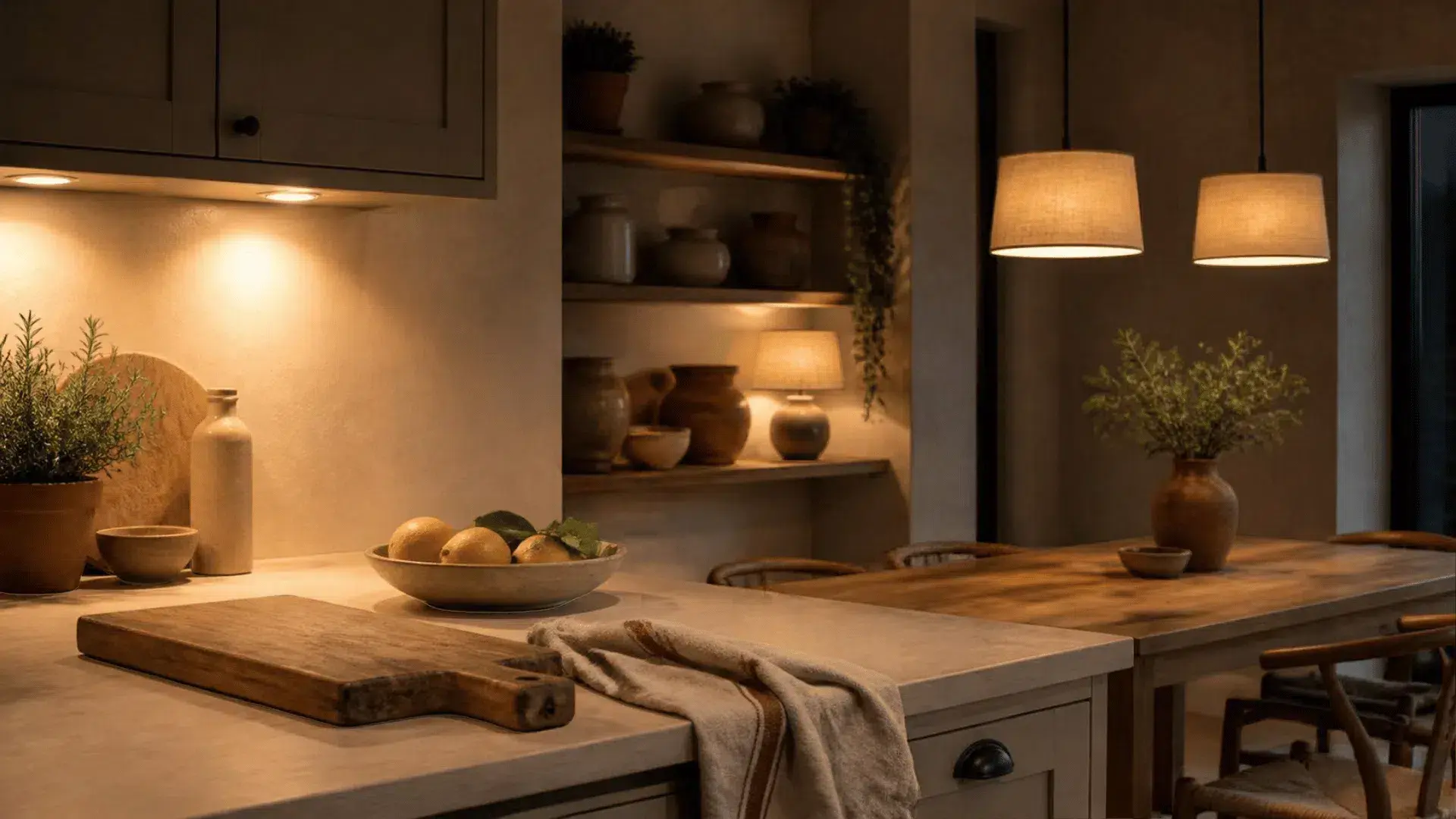
Kitchens ask more of their lighting than almost any other room.
For preparing food they need clear, shadow-free light, and softer light helps with eating and relaxing.
In many homes, kitchen lighting ideas help one open-plan space shift from busy family room to calm evening room.
This guide sets out practical kitchen lighting ideas using the three layers of light: ambient, task and accent. For the principles behind them, see our home lighting ideas.
Use All Three Layers
A single ceiling light rarely works in a kitchen. Standing at a worktop with the light behind you casts your own shadow over the chopping board. Layering solves this: ambient light for the room, task light where you work, and accent light to make the space feel welcoming.
Under-Cabinet Task Lighting for Worktops
- Under-cabinet lighting: lights beneath wall cupboards put light directly on the worktop, in front of you rather than behind.
- Positioned ceiling lights: if there are no wall cupboards, place ceiling lights over the front edge of worktops rather than in the middle of the room.
- Hob and sink: make sure both are well lit; extractor hoods often include task lights.
- Islands: pendants or spotlights above an island give task light for preparation and a focal point.
For under-cabinet strips, hiding the source and using diffusion avoids glare on glossy worktops; see our LED strips guide.
Ambient Kitchen Lighting and Ceiling Light Fittings
Ambient light should be even enough to move around safely. Several evenly spaced ceiling lights spread light better than one central fitting. Putting ambient and task lights on separate switches lets you turn down the room while keeping the worktop lit.
Colour Temperature and Brightness
Kitchens are one of the rooms where slightly cooler light can be practical. The Energy Saving Trust notes cool white (4000–4500K) may suit kitchens and bathrooms, while warm white (2700–3000K) suits most household lighting. In open-plan kitchen-living rooms, warm white usually keeps the space feeling connected, with brighter task light on worktops.
Colour rendering also matters where you prepare food: the Energy Saving Trust suggests a colour rendering index (CRI) of 80 or more for most household tasks, and higher values show the colours of food more naturally.
Lighting a Kitchen Dining Area
Light the table rather than the whole room. A pendant or pair of pendants should hang at a comfortable height, ideally on a dimmer. These are practical kitchen lighting ideas. When the cooking is done, dim the ambient light. Switch off the worktop lights and let the table light and a lamp or two take over. Unscented candles add warmth without competing with food. See our natural candles guide.
Accent and Evening Light
Accent light makes a kitchen feel like part of the home rather than a workspace: a lamp on a dresser or open shelf, soft light inside glass-fronted cabinets or a glow along a plinth. A table lamp on a kitchen shelf is one of the simplest ways to soften the room in the evening.
Small Kitchens and Galleys
In small kitchens, bright, even light makes the space feel larger. Light the worktops well, use pale surfaces to bounce light, and keep fittings slim and close to the ceiling. Under-cabinet lighting is especially effective in galley kitchens.
Open-Plan Kitchen-Living Rooms
Treat the space as zones. Give the kitchen, dining and seating areas their own lighting and their own switches, keep colour temperature consistent across them, and use lamps in the living zone so it can feel separate in the evening. Smart lighting scenes can help switch between zones; see our smart lighting guide.
Practical and Safety Notes
- Use fittings suitable for kitchen conditions, especially near the hob and sink.
- Have any fixed wiring installed by a qualified electrician.
- Keep lamps and cables away from water and heat sources.
- Choose LED bulbs, which the Energy Saving Trust recommends for almost every situation.
Common Kitchen Lighting Mistakes
- Relying on one central ceiling light.
- Placing ceiling lights so you stand in your own shadow.
- Putting all kitchen lights on one switch.
- Mixing very warm and very cool light in an open-plan space.
- Leaving the dining area without dimmable light.
Frequently Asked Questions About Kitchen Lighting
What is the best lighting for a kitchen?
A combination of even ambient light, task lighting on worktops, and a dimmable light over the dining area works well.
These kitchen lighting ideas include separate switches for each element.
Should kitchen lights be warm or cool white?
Warm white suits most kitchens and open-plan spaces; slightly cooler white can work for task areas in kitchens used mainly for cooking.
How do I make my kitchen feel cosy in the evening?
Dim or switch off the ceiling lights, keep a low light over the table, and add a lamp or soft accent light on shelves or a dresser.
Light the Kitchen for Every Part of the Day
A well-lit kitchen works hard during the day and softens in the evening. Layer the light, give each zone its own switch and keep a lamp or two for the end of the day. Explore our lighting collection for table lamps that suit kitchen shelves and dining areas.
LIGHTING & AMBIENCE
Explore Lighting & Ambience

Leave a Reply