

SPACE & LIGHT · LIGHTING & AMBIENCE
Battery-Operated Light Bulbs: Where Cordless Lighting Is Most Useful
A practical guide to battery-operated and rechargeable light bulbs—covering where cordless lighting is genuinely useful, how to judge brightness and runtime, and when a conventional wired fitting is still the better choice.

A battery operated light bulb solves a very specific problem: you want useful light where there is no convenient mains connection, or you want a lamp to move without being tied to a cable. That can be genuinely helpful—but cordless lighting is usually strongest as a flexible secondary layer rather than a replacement for every wired light in a room.
Rechargeable light bulbs and battery-powered lamps now appear in table lamps, wall lights, pendants and portable fittings. The important questions are practical: how bright is the light, how long does the battery last at the brightness you actually use, how is it charged, and can you reach the controls easily?
For the broader lighting plan, including ambient, task and accent layers, see our guide to lighting for a sitting room. This article focuses on when removing the cable is genuinely useful.
What Battery-Operated Light Bulbs Are
The term covers several different products. Some are rechargeable LED bulbs designed to screw into a conventional lamp holder but operate from their own battery. Others are integrated cordless lamps whose LED source and battery are built into the fitting.
There are also bulbs sold for emergency use that charge while connected to mains power and switch to battery power during an outage. Those are a different use case from a bulb chosen specifically to make a table or wall lamp cordless.
Before buying, check exactly how the product is powered, charged and controlled rather than assuming every “battery bulb” works in the same way.
Where Cordless Lighting Is Most Useful
Cordless lighting earns its place when the absence of a cable solves a real layout problem.
- A side table that sits away from a wall socket.
- A console in a hallway or living room where a trailing cable would be awkward.
- A wall lamp where new wiring would be disproportionate to the amount of light required.
- A shelf or alcove that needs a small pool of occasional light.
- A portable lamp that moves between indoor seating areas.
- Temporary lighting while a room layout is still being tested.
The common factor is flexibility. If the light needs to run for hours every evening at high output, a permanent mains-powered fitting may be more convenient.
Table Lamps Without a Nearby Socket
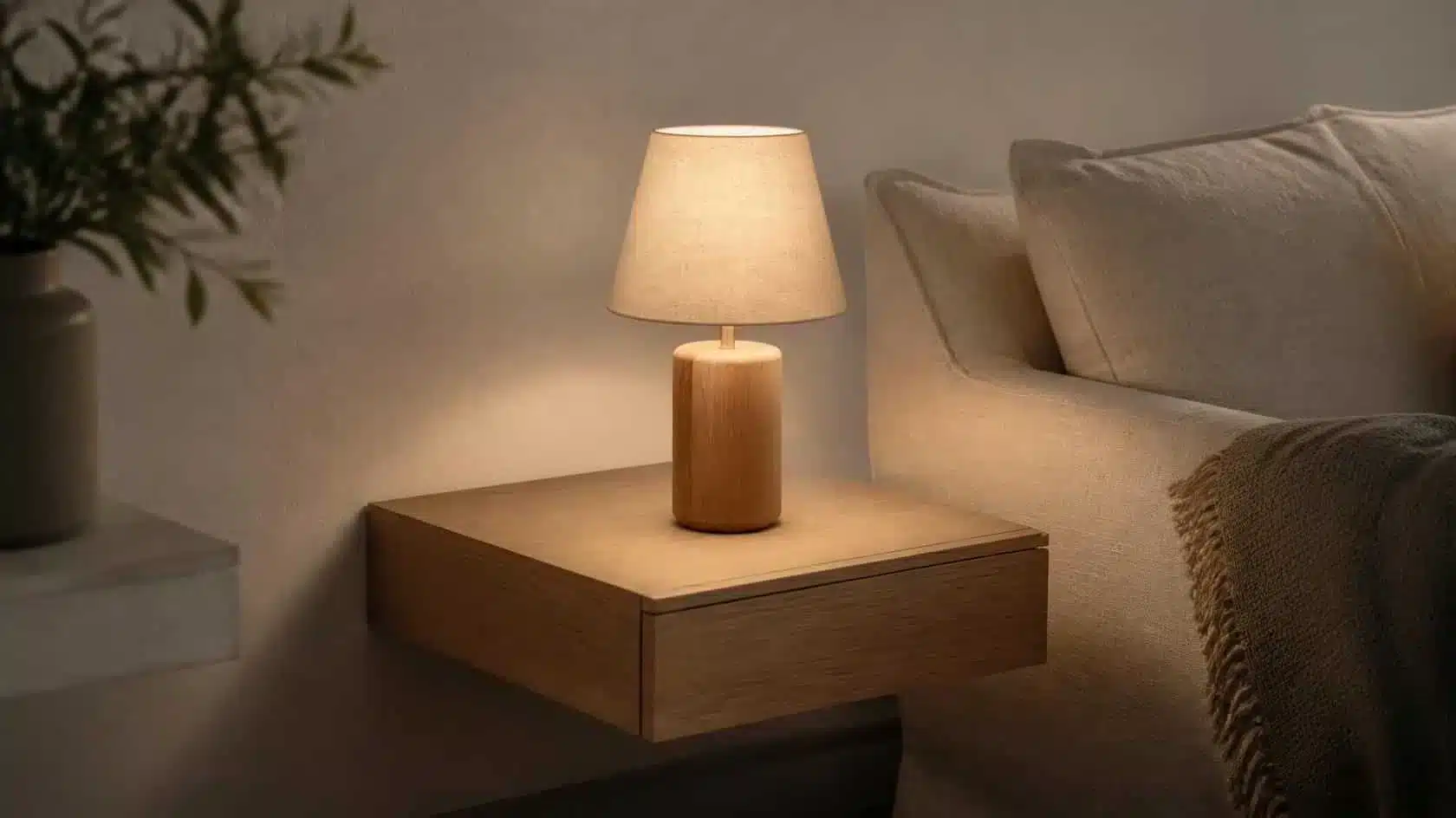
A battery-powered bulb can make a conventional-looking table lamp useful in the centre of a room, on a floating side table or on furniture where a cable would otherwise cross a walkway.
This is most successful when the lamp is used for atmosphere rather than demanding task light. Lower-output evening use extends runtime and makes the need to recharge less intrusive.
Cordless Wall Lamps

Cordless wall lamps are useful when you want light on a vertical surface but do not want to chase wiring into the wall. They can work beside a sofa, over a small console or in a rental where permanent electrical work is undesirable.
They still need thoughtful placement. Our guide to a wall lamp for living room use covers height, glare, seating positions and how wall light relates to furniture.
Shelves, Alcoves and Display Areas

A small rechargeable light can be useful on shelving where adding a wired fitting would require visible cable or joinery work. It can create a pool of evening light around books or objects without becoming part of the permanent electrical scheme.
Keep expectations realistic. A compact battery light is usually better at accent illumination than lighting a large display wall evenly.
Temporary and Flexible Lighting
Cordless lights are especially useful while you are deciding where permanent fittings belong. Move a lamp around the room for several evenings and observe where the extra light improves the space before committing to wiring or a new socket.
They can also be useful for occasional situations: a dining table moved for guests, a temporary reading position or a darker corner used only at certain times of year.
Check Lumens Before Buying
Do not judge a rechargeable bulb by wattage alone. Watts describe power consumption; lumens describe light output.
The Energy Saving Trust recommends using lumen output to compare LED brightness because LEDs can produce useful light with much lower wattage than older lamp technologies.
For cordless lighting, lumens matter twice: they tell you whether the light will be bright enough, and higher output will usually affect how quickly the battery is used.
Treat Runtime as a Real Specification
“Up to” runtime figures often refer to the lowest brightness setting. Check whether the manufacturer gives separate runtimes for high, medium and low output.
Think about how the lamp will actually be used. A decorative lamp switched on for two hours after dinner has very different demands from a reading lamp expected to run for an entire evening.
Brightness and Runtime Trade Off
A cordless lamp cannot provide unlimited brightness for unlimited time. More light requires more stored energy.
This is why dimming is more than an atmospheric feature in rechargeable lighting. Running a bulb at a lower setting may extend useful time between charges while also producing a softer evening layer.
Choose a Comfortable Colour Temperature
For living areas, warm-white light often integrates more easily with table lamps and wall lights than a very cool white source.
The Energy Saving Trust describes around 2700K as very warm white and roughly 2700–3000K as warm white, with these ranges generally suited to living areas and household lighting.
If the cordless lamp will sit beside existing lights, compare their colour temperatures so the room does not feel split between noticeably different white tones.
Plan How the Light Will Be Charged
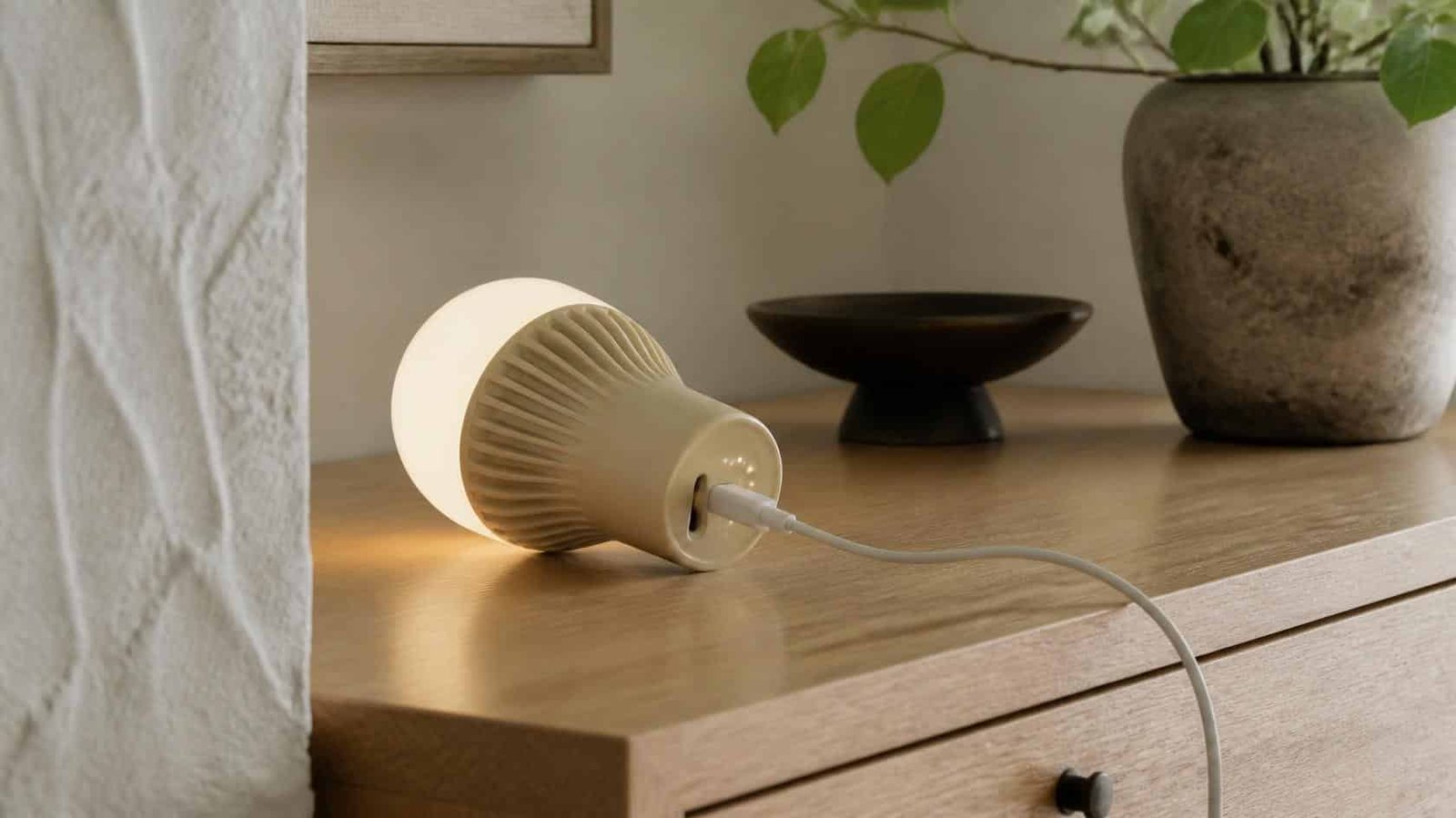
A cordless light stops feeling convenient if charging it requires dismantling the lamp or carrying an awkward fitting across the room every night.
- Check whether the bulb itself must be removed for charging.
- Check whether the fitting uses USB-C, a proprietary cable or a charging base.
- Make sure the charging port remains accessible after installation.
- Keep the correct charger or cable easy to identify and store.
The best cordless system is one whose charging routine fits naturally into the room.
Remote Controls, Timers and Touch Controls
Remote controls can be helpful when the bulb is inside a shade or mounted above normal reach. Timers are useful for accent lighting that operates for a predictable part of the evening. Our guide to light automation at home covers schedules, sunset timing and scenes.
Touch controls work well on portable lamps, but think about where the lamp will sit. A control that is elegant on a bedside lamp can be awkward on a wall fitting mounted beyond easy reach.
Check the Bulb Base and Physical Fit
A rechargeable bulb still needs to fit the lamp physically. Check the cap type—such as E27 or B22—along with the bulb diameter, overall length and whether the lamp shade leaves room for the battery housing.
Some rechargeable bulbs are larger or heavier than a conventional LED bulb. That matters in small shades, delicate fittings and lamps where the bulb sits horizontally.
Battery Bulbs and Emergency Bulbs Are Not the Same
Some rechargeable bulbs are designed primarily for power cuts. They charge while connected to a mains fitting and use their stored battery when the supply fails.
That is different from a bulb intended to make an otherwise unpowered lamp cordless. Read the operating instructions carefully, because an emergency bulb may rely on the fitting and circuit behaving in a particular way before its battery mode activates.
Rechargeable Battery Safety
Rechargeable lighting often contains lithium-ion batteries. Follow the manufacturer’s charging instructions, keep the product and charger in good condition, and stop using equipment that becomes abnormally hot, swollen, cracked or otherwise damaged.
Electrical Safety First advises buying rechargeable electrical products and chargers from reputable retailers, keeping battery products away from excessive heat and water, and avoiding prolonged unattended charging where the manufacturer does not support it.
When Wired Lighting Is Still Better
Cordless is not automatically better. Mains-powered lighting is usually the more practical choice where a fitting is used every day for long periods, needs high output or is part of the permanent ambient lighting of the room.
A wired fitting also removes the charging cycle. If a lamp already sits beside a socket and the cable can be managed neatly, converting it to battery power may solve a problem that does not actually exist.
Frequently Asked Questions About Battery-Operated Light Bulbs
Do battery-operated light bulbs need to be plugged in?
Not while operating from their battery, but rechargeable models still need a charging source. The charging method varies: some bulbs are removed and charged directly, while integrated cordless lamps may use USB or a charging base.
How long do rechargeable light bulbs last on a charge?
Runtime varies widely with battery capacity and brightness. Check the manufacturer’s runtime at the output level you expect to use rather than relying only on a maximum “up to” figure.
Are battery-powered bulbs bright enough for reading?
Some are, but check the lumen output and beam position. A lower-output cordless bulb may be excellent for atmosphere but inadequate for sustained reading.
Can I use a battery bulb in any lamp?
Only if the base, dimensions and operating method are compatible with the lamp. Rechargeable bulbs can be larger or heavier than ordinary LED bulbs, so check the physical fit as well as the cap type.
Are rechargeable bulbs better than cordless lamps?
They solve different problems. A rechargeable bulb can adapt an existing lamp, while an integrated cordless lamp may provide a cleaner charging system and purpose-designed controls. Choose according to the furniture, placement and charging routine.
Use Cordless Light Where Flexibility Matters
Battery-operated lighting is most useful when freedom from a cable materially improves the room.
Use it for movable table lamps, difficult wall positions, shelves, alcoves and temporary layouts. Check lumens, runtime, colour temperature, charging access and physical fit before buying, and keep battery safety part of the decision rather than an afterthought.
Where the light is permanent, bright and used for long periods, a wired source may still be the quieter and more practical solution.

Leave a Reply